RankRizz

Ray Optics & Optical Instruments — JEE Advanced Previous Year Questions

Every Ray Optics & Optical Instruments question JEE Advanced has set from 2007–2026, grouped by the idea it tests rather than the order of the syllabus. 61 questions across 6 distinct ideas. Free to read, answer key on every one.

Questions

61

Distinct ideas

6

Share of marks

8%

Difficulty

HARD

The ideas inside Ray Optics & Optical Instruments

A chapter is not one subject — it is a handful of procedures the examiner reuses. These are the ones Ray Optics & Optical Instruments questions actually test.

01Reflection and plane mirrorsset 5×
02Spherical mirrors: mirror formula and magnificationset 4×
03Refraction at plane surfaces, Snell's law and apparent depthset 7×
04Total internal reflection and critical angleNot set in Advanced
05Refraction at spherical surfacesNot set in Advanced
06Thin lenses: lens formula, lens maker's formula and powerset 4×
07Combinations of lenses and mirrorsset 15×
08Prism: deviation and dispersionset 26×
09Optical instruments: microscopes and telescopesNot set in Advanced

Every Ray Optics & Optical Instruments question

21–40 OF 61 · NEWEST FIRST

JEE ADVANCED 2019 · PAPER 2Prism: deviation and dispersionTRANSCRIBED

Three glass cylinders of equal height H = 30 cm and same refractive index n = 1.5 are placed on a horizontal surface as shown in figure. Cylinder I has a flat top, cylinder II has a convex top and cylinder III has a concave top. The radu of curvature of the two curved tops are same (R = 3 m). If H1,H2H_1, H_2 and H3H_3 are the apparent depths of a point_X on the bottom of the three cylinders, respectively, the correct statement(s) is/are:
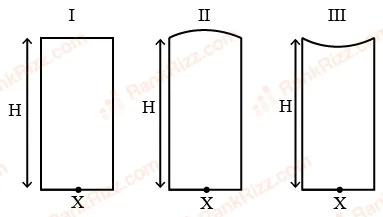
Figure for JEE Advanced 2019 Physics question on Prism: deviation and dispersion
  1. A

    H2>H1H_2 > H_1

  2. B

    H3>H1H_3 > H_1

  3. C

    H2>H3H_2 > H_3

  4. D

    0.8 cm <(H2−H1)<0.9< (H_2 - H_1) < 0.9 cm

JEE ADVANCED 2019 · PAPER 1Combinations of lenses and mirrorsTRANSCRIBED

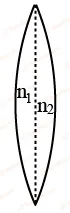
A thin convex lens is made of two materials with refractive indices n1andn2n_1 and n_2 as shown in figure. The radius of curvature of the left and right spherical surfaces are equal. f is the focal length of the lens when n1=n2=n.n_1 = n_2 = n. The focal length is f+△ff + \triangle f when n1=nn_1 = n and n2=n+△nn_2 = n + \triangle n. Assuming △n≪(n—1)\triangle n \ll (n — 1) and 1 < n < 2, the correct statement(s) is/are

Figure for JEE Advanced 2019 Physics question on Combinations of lenses and mirrors
  1. A

    ∣△ff∣<∣△nn∣| \frac {\triangle f}{f}| < | \frac {\triangle n}{n}|

  2. B

    For n=1.5,△n=10−3n = 1.5, \triangle n = 10^{-3} and f = 20 cm,the value of ∣△f∣|\triangle f| will be 0.02 cm (round off to 2nd2^{nd} decimalplace).

  3. C

    If △nn<0then△ff>0\frac {\triangle n}{n} < 0 then \frac {\triangle f}{f} > 0

  4. D

    The relation between △ffand△nn\frac {\triangle f}{f} and \frac {\triangle n}{n} remains unchanged if both the convex surfaces are replaced by concave surfaces of the same radius of curvature.

JEE ADVANCED 2019 · PAPER 2Prism: deviation and dispersionTRANSCRIBED

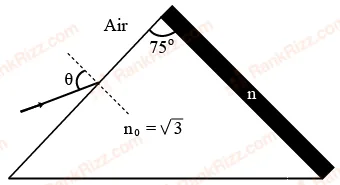
A monochromatic light is incident from air on a refracting surface of a prism of angle 75∘75^\circ and refractive index n0=3n_0 = \sqrt 3. The other refracting surface of the prism is coated by a thin film of material of refractive index n as shown in figure. The light suffers total internal reflection at the coated prism surface for an incidence angle of θ≤60∘\theta \leq 60^\circ. The value of n2n^2 is ___________ .

Figure for JEE Advanced 2019 Physics question on Prism: deviation and dispersion
JEE ADVANCED 2019 · PAPER 1Prism: deviation and dispersionTRANSCRIBED

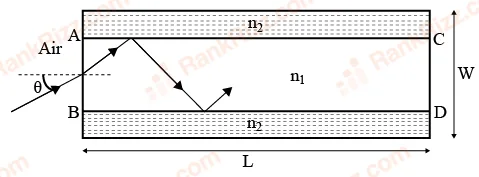
A planar structure of length £ and width W is made of two different optical media of refractive indices n1=1.5andn2=1.44n_1 = 1.5 and n_2 = 1.44 as shown in figure. If L≫WL \gg W, a ray entering from end AB will emerge from end CD only if the total internal reflection condition is met inside the structure. For L = 9.6 m, if the incident angle θ\theta is varied, the maximum time taken by array to exit the plane CD is t×10−9st \times 10^{-9} s, where t is _______.
[ Speed of light c=3×10⁸m/sc = 3 \times 10^8 m/s]

Figure for JEE Advanced 2019 Physics question on Prism: deviation and dispersion
JEE ADVANCED 2018 · PAPER 1Combinations of lenses and mirrorsTRANSCRIBED

Sunlight of intensity 1.3 kW𝑚−2kW 𝑚^{−2} is incident normally on a thin convex lens of focal length 20 𝑐𝑚. Ignore the energy loss of light due to the lens and assume that the lens aperture size is much smaller than its focal length. The average intensity of light, in kW𝑚−2kW 𝑚^{−2}, at a distance 22 𝑐𝑚 from the lens on the other side is __________

JEE ADVANCED 2017 · PAPER 1Prism: deviation and dispersionTRANSCRIBED

For an isosceles prism of angle 𝐴 and refractive index μ\mu, it is found that the angle of minimum deviation δm=A\delta_m = A. Which of the following options is/are correct?

  1. A

    For the angle of incidence i1=Ai_1 = A, the ray inside the prism is parallel to the base of the prism

  2. B

    For this prism, the refractive index μ\mu and the angle of prism 𝐴 are related as A=12cos⁡−1(μ2)A = \frac{1}{2} \cos^{-1}\left(\frac{\mu}{2}\right)

  3. C

    At minimum deviation, the incident angle i1i_1 and the refracting angle r1r_1 at the first refracting surface are related by r1=(i1/2)r_1 = (i_1/2)

  4. D

    For this prism, the emergent ray at the second surface will be tangential to the surface when the angle of incidence at the first surface is i1=sin⁡−1[sin⁡A4cos⁡2A2−1−cos⁡A]i_1 = \sin^{-1} \left[\sin A \sqrt{4 \cos^2 \frac{A}{2} - 1} - \cos A\right]

JEE ADVANCED 2017 · PAPER 1Prism: deviation and dispersionTRANSCRIBED

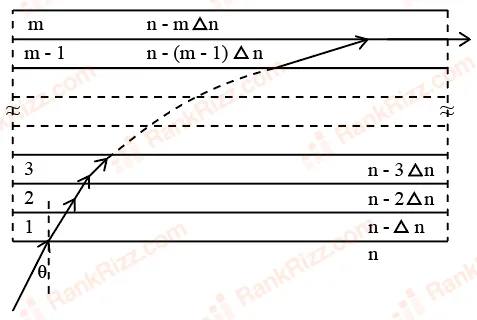
A monochromatic light is travelling in a medium of refractive index n = 1.6. It enters a stack of glass layers from the bottom side at an angle θ=30∘\theta = 30^\circ. The interfaces of the glass layers are parallel to each other. The refractive indices of different glass layers are monotonically decreasing as nm=n−m△nn_m = n - m \triangle n, where nmn_m is the refractive index of the mthm^{th} slab and △n=0.1\triangle n = 0.1 (see the figure) The ray is refracted out parallel to the interface between the (m−1)th(m - 1)^{th} and mthm^{th} slabs from the right side of the stack. What is the value of m?

Figure for JEE Advanced 2017 Physics question on Prism: deviation and dispersion
JEE ADVANCED 2016 · PAPER 1Prism: deviation and dispersionTRANSCRIBED

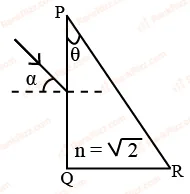
A parallel beam of light is incident from air at an angle a on the side PQ of a right angled triangular prism of refractive index n=2n = \sqrt{2}. Light undergoes total internal reflection in the prism at the face PR when a has a minimum value of 45∘45^\circ. The angle θ\theta of the prism is

Figure for JEE Advanced 2016 Physics question on Prism: deviation and dispersion
  1. A

    15∘15^\circ

  2. B

    22.5∘22.5^\circ

  3. C

    30∘30^\circ

  4. D

    45∘45^\circ

JEE ADVANCED 2016 · PAPER 2Combinations of lenses and mirrorsTRANSCRIBED

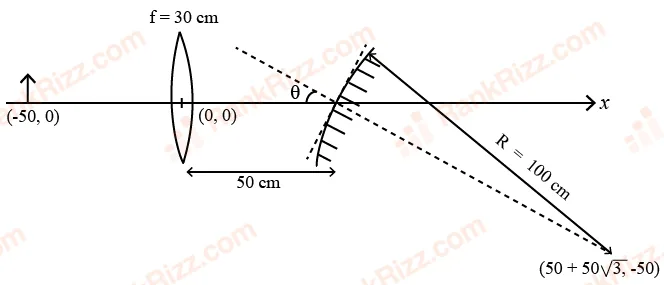
A small object is placed 50 cm to the left of a thin convex lens of focal length 30 cm. A convex spherical mirror of radius of curvature 100 cm is placed to the right of the lens at a distance of 50 cm. The mirror is tilted such that the axis of the mirror is at an angle θ=30∘\theta = 30^\circ to the axis of the lens, as shown in the figure.

Figure for JEE Advanced 2016 Physics question on Combinations of lenses and mirrors

If the origin of the coordinate system is taken to be at the center of the lens, the coordinates (in cm) of the point (x,y) at which the image is formed are

  1. A

    (0,0)(0, 0)

  2. B

    (50−253,25)(50-25\sqrt{3}, 25)

  3. C

    (25,253)(25, 25\sqrt{3})

  4. D

    (1253,253)\left(\frac{125}{3}, \frac{25}{\sqrt{3}}\right)

JEE ADVANCED 2016 · PAPER 1Combinations of lenses and mirrorsTRANSCRIBED

A plano-convex lens is made ofa material of refractive index n. When a smallobject is placed 30 cm awayin front of the curved surface of the lens, an image of double the size of the object is produced. Dueto reflection from the convex surface of the lens, another faint image is observed at a distance of 10 cm away from the lens. Which of the following statement(s)
is(are) true?

  1. A

    The refractive index of the lens is 2.5

  2. B

    The radius of curvature of the convex surface is 45 cm

  3. C

    The faint image is erect and real

  4. D

    The focal length of the lens is 20 cm

JEE ADVANCED 2016 · PAPER 1Prism: deviation and dispersionTRANSCRIBED

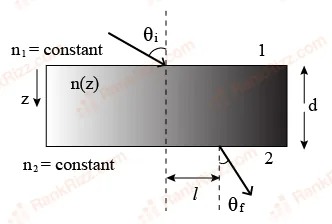
A transparent slab of thickness d has a refractive index n(z) that increases with z. Here z is the vertical distance inside the slab, measured from the top. The slab is placed between two media with uniform refractive indices n1n_1 and n2(>n1)n_2(> n_1), as shown in the figure. A ray of light is incident with angle θi\theta_i from medium 1 and emerges in medium 2 with refraction angle θf\theta_f, with a lateral displacement l.

Figure for JEE Advanced 2016 Physics question on Prism: deviation and dispersion

Which of the following statement(s) is(are) true?

  1. A

    n1sin⁡θi=n2sin⁡θfn_1 \sin \theta_i = n_2 \sin \theta_f

  2. B

    n1sin⁡θi=(n2−n1)sin⁡θfn_1 \sin \theta_i = (n_2 - n_1) \sin \theta_f

  3. C

    l is independentof n2n_2

  4. D

    l is dependenton n(z)

JEE ADVANCED 2015 · PAPER 2Prism: deviation and dispersionTRANSCRIBED

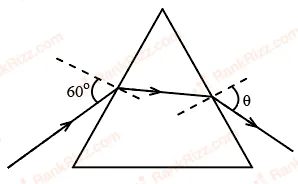
A monochromatic beam of light is incident at 60∘60^\circ on one face of an equilateral prism of refractive index n and emerges from the opposite face making an angle θ(n)\theta(n) with the normal (see the figure). For n=3n = \sqrt 3 the value of θ\theta is 60∘60^\circ and dθdn=m\frac{d \theta}{dn} = m. The value of m is

Figure for JEE Advanced 2015 Physics question on Prism: deviation and dispersion
JEE ADVANCED 2015 · PAPER 1Combinations of lenses and mirrorsTRANSCRIBED

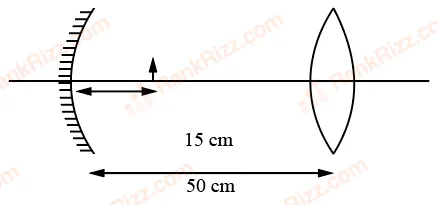
Consider a concave mirror and a convex lens (refractive index = 1.5) of focal length 10 cm each, separated by a distance of 50 cm in air (refractive index = 1) as shown in the figure. An object is placed at a distance of 15 cm from the mirror. Its erect image formed by this combination has magnification M1M_1. When the set-up is kept in a medium of refractive index 76\frac{7}{6}, the magnification becomes M2M_2. The magnitude ∣M2M1∣\mid \frac{M_2}{M_1} \mid is

Figure for JEE Advanced 2015 Physics question on Combinations of lenses and mirrors
JEE ADVANCED 2015 · PAPER 1Combinations of lenses and mirrorsTRANSCRIBED

Two identical glass rods S1S_1 and S2S_2 (refractive index = 1.5) have one convex end of radius of curvature 10 cm. They are placed with the curved surfaces at a distance d as shown in the figure, with their axes (shown by the dashed line) aligned. When a point source of light P is placed inside rod S1S_1 on its axis at a distance of 50 cm from the curved face, the light rays emanating from it are found to be parallel to the axis inside S2S_2. The distance d is

Figure for JEE Advanced 2015 Physics question on Combinations of lenses and mirrors
  1. A

    60 cm

  2. B

    70 cm

  3. C

    80 cm

  4. D

    90 cm

JEE ADVANCED 2015 · PAPER 2Prism: deviation and dispersionTRANSCRIBED

For two structures namely S1S_1 with n1=454n_1 = \frac{\sqrt 45}{4} and n2=32n_2 = \frac{3}{2}, and S2S_2 with n1=85n_1 = \frac{8}{5} and n2=75n_2 = \frac{7}{5} and taking the refractive index of water to be 43\frac{4}{3} and that of air to be 1, the correct option(s) is(are)

  1. A

    NA of S1S_1 immersed in water is the sameas that of S2S_2 immersed in liquid of refractive index 16315\frac{16}{3\sqrt 15}

  2. B

    NA of S1S_1 immersed in liquid of refractive index 615\frac{6}{\sqrt 15} is the same as that of S2S_2 immersed in water

  3. C

    NA of S1S_1 placed in air is the same as that of S2S_2 immersed in liquid of refractive index 415\frac{4}{\sqrt 15}

  4. D

    NA of S1S_1 placed in air is the same as that of S2S_2 placed in water

JEE ADVANCED 2015 · PAPER 2Prism: deviation and dispersionTRANSCRIBED

If two structures of same cross-sectional area, but different numerical apertures NA1NA_1 and NA2(NA2<NA1)NA_2 (NA_2 < NA_1) are joined longitudinally, the numerical aperture of the combined structure is

  1. A

    NA1NA2NA1+NA2\frac{NA_1 NA_2}{NA_1 + NA_2}

  2. B

    NA1+NA2NA_1 + NA_2

  3. C

    NA1NA_1

  4. D

    NA2NA_2

JEE ADVANCED 2014 · PAPER 2Prism: deviation and dispersionTRANSCRIBED

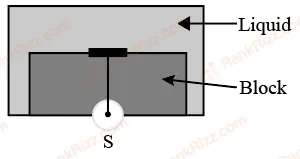
A point source S is placed at the bottom of a transparent block of height 10 mm and refractive index 2.72. It is immersed in a lower refractive index liquid as shown in the figure. It is found that the light emerging from the block to the liquid forms a circular bright spot of diameter 11.54 mm on the top of the block. The refractive index of the liquid is

Figure for JEE Advanced 2014 Physics question on Prism: deviation and dispersion
  1. A

    1.21

  2. B

    1.30

  3. C

    1.36

  4. D

    1.42

JEE ADVANCED 2014 · PAPER 1Combinations of lenses and mirrorsTRANSCRIBED

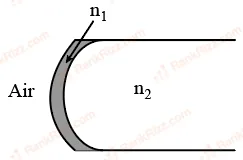
A transparent thin film of uniform thickness and refractive index n1=1.4n_1 = 1.4 is coated on the convex spherical surface of radius Rat one end of a long solid glass cylinder of refractive index n2=1.5,n_2 = 1.5, as shown in the figure. Rays of light parallel to the axis of the cylinder traversing through the film from air to glass get focused at distance f1f_1 from the film, while rays of light traversing from glass to air get focused at distance f2f_2 from the film. Then

Figure for JEE Advanced 2014 Physics question on Combinations of lenses and mirrors
  1. A

    ∣f1∣=3R|f_1| = 3R

  2. B

    ∣f1∣=2.8R|f_1| = 2.8R

  3. C

    ∣f2∣=2R|f_2| = 2R

  4. D

    ∣f2∣=1.4R|f_2| = 1.4R

JEE ADVANCED 2014 · PAPER 2Combinations of lenses and mirrorsTRANSCRIBED

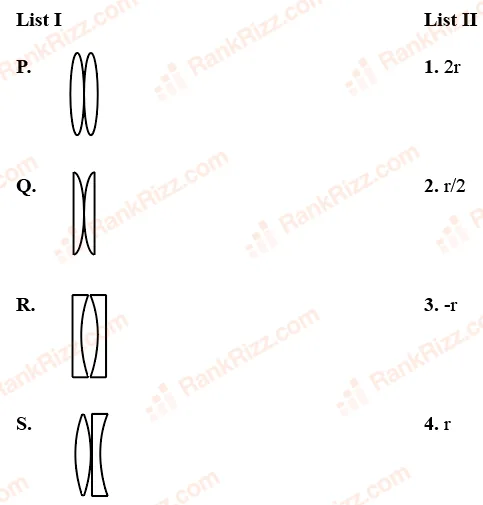
Four combinations of two thin lenses are given in List I. The radius of curvature of all curved surfaces is r and the refractive index of all the lenses is 1.5. Match lens combinations in List I with their focal length in List II and select the correct answer using the code given below the lists.

Figure for JEE Advanced 2014 Physics question on Combinations of lenses and mirrors


Choices:

  1. A

    P-1, Q-2, R-3, S-4

  2. B

    P-2, Q-4, R-3, S-1

  3. C

    P-4, Q-1, R-2, S-3

  4. D

    P-2, Q-1, R-3, S-4

JEE ADVANCED 2013 · PAPER 1Reflection and plane mirrorsTRANSCRIBED

A ray oflight travelling in the direction 12(i^+3j^)\frac{1}{2} \left(\widehat{i} + \sqrt 3 \widehat{j}\right) is incident on a plane mirror. After reflection, it travels along the direction 12(i^−3j^)\frac{1}{2} \left(\widehat{i} - \sqrt 3 \widehat{j}\right). The angle of incidence is

  1. A

    30∘30^\circ

  2. B

    45∘45^\circ

  3. C

    60∘60^\circ

  4. D

    75∘75^\circ