JEE Advanced 2016 Physics question — Combinations of lenses and mirrors
A small object is placed 50 cm to the left of a thin convex lens of focal length 30 cm. A convex spherical mirror of radius of curvature 100 cm is placed to the right of the lens at a distance of 50 cm. The mirror is tilted such that the axis of the mirror is at an angle to the axis of the lens, as shown in the figure.
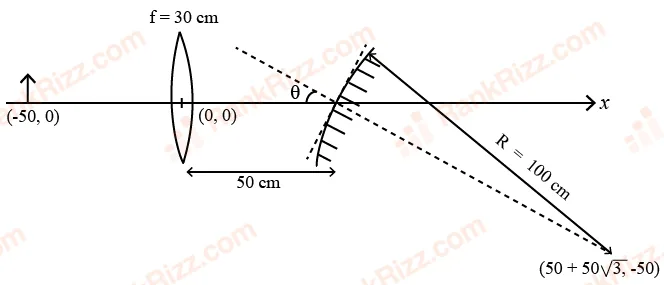
If the origin of the coordinate system is taken to be at the center of the lens, the coordinates (in cm) of the point (x,y) at which the image is formed are
SOLUTION
Key idea: The lens image acts as a virtual object for the tilted convex mirror. Then find where the mirror's image lies along the reflected direction.
- Lens (, ): The rays converge towards , which is 25 cm beyond the mirror's pole at . This is a virtual object 25 cm behind the mirror.
- Convex mirror ( cm behind the mirror, virtual object cm): So a real image forms 50 cm in front of the mirror.
- The central ray along the lens axis strikes the pole. The mirror's normal there is at to the x-axis, so the ray reflects off at from the reversed direction, i.e. along a line at to .
- Image position, 50 cm from the pole along that line:
Answer: (C)
Tagged Combinations of lenses and mirrors. Machine-assigned, so read it as a strong shortlist rather than a verdict.