JEE ADVANCED 2016 · PAPER 1+4 / −2MEDIUMTRANSCRIBED
JEE Advanced 2016 Physics question — Prism: deviation and dispersion
A transparent slab of thickness d has a refractive index n(z) that increases with z. Here z is the vertical distance inside the slab, measured from the top. The slab is placed between two media with uniform refractive indices and , as shown in the figure. A ray of light is incident with angle from medium 1 and emerges in medium 2 with refraction angle , with a lateral displacement l.
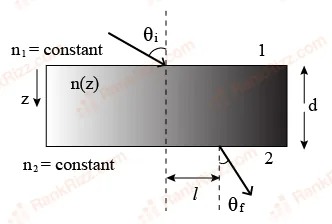
Which of the following statement(s) is(are) true?
SOLUTION
Key idea: Treat the graded slab as many thin layers. stays the same across every boundary.
- Applying Snell's law layer by layer gives . So (A) is true and (B) is false.
- Lateral displacement: , where .
- This integral depends on , so (D) is true. It involves only and inside the slab, and affects only the final emergent angle . So (C) is true.
Answer: (A), (C), (D)
Tagged Prism: deviation and dispersion. Machine-assigned, so read it as a strong shortlist rather than a verdict.