RankRizz

Ray Optics & Optical Instruments — JEE Advanced Previous Year Questions

Every Ray Optics & Optical Instruments question JEE Advanced has set from 2007–2026, grouped by the idea it tests rather than the order of the syllabus. 61 questions across 6 distinct ideas. Free to read, answer key on every one.

Questions

61

Distinct ideas

6

Share of marks

8%

Difficulty

HARD

The ideas inside Ray Optics & Optical Instruments

A chapter is not one subject — it is a handful of procedures the examiner reuses. These are the ones Ray Optics & Optical Instruments questions actually test.

01Reflection and plane mirrorsset 5×
02Spherical mirrors: mirror formula and magnificationset 4×
03Refraction at plane surfaces, Snell's law and apparent depthset 7×
04Total internal reflection and critical angleNot set in Advanced
05Refraction at spherical surfacesNot set in Advanced
06Thin lenses: lens formula, lens maker's formula and powerset 4×
07Combinations of lenses and mirrorsset 15×
08Prism: deviation and dispersionset 26×
09Optical instruments: microscopes and telescopesNot set in Advanced

Every Ray Optics & Optical Instruments question

41–60 OF 61 · NEWEST FIRST

JEE ADVANCED 2013 · PAPER 1Combinations of lenses and mirrorsTRANSCRIBED

The image of an object, formed by a plano-convex lens at a distance of 8 m behind the lens, is real and is one-third the size of the object. The wavelength oflight inside the lens is 23\frac{2}{3} times the wavelength in free space. The radius of the curved surface of the lens is

  1. A

    1 m

  2. B

    2 m

  3. C

    3 m

  4. D

    6 m

JEE ADVANCED 2013 · PAPER 2Prism: deviation and dispersionTRANSCRIBED

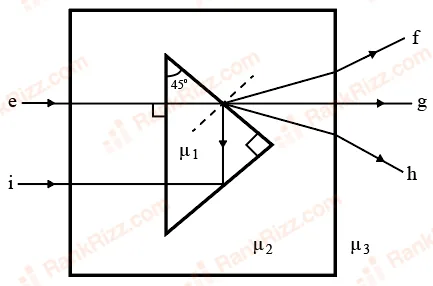
A right angled prism of refractive index μ1\mu_{1} is placed in a rectangular block of refractive index μ2\mu_{2}, which is surrounded by a medium of refractive index μ3\mu_{3}, as Shown in the figure. A ray of light ‘e’ enters the rectangular block at normal incidence. Depending upon the relationships between μ1,μ2\mu_{1},\mu_{2} and μ3\mu_{3}, it takes one of the four possible paths ‘ef’, ‘eg’, ‘eh’ or ‘ei’.

Figure for JEE Advanced 2013 Physics question on Prism: deviation and dispersion


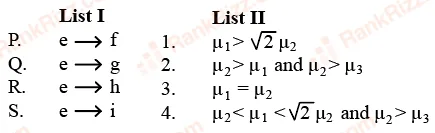
Match the paths in List I with conditions of refractive indices in List II and select the correct answer using the codes given below the lists:

Figure for JEE Advanced 2013 Physics question on Prism: deviation and dispersion
  1. A

    P-2, Q-2, R-1, S-4

  2. B

    P-1, Q-2, R-4, S-3

  3. C

    P-4, Q-1, R-2, S-3

  4. D

    P-2, Q-3, R-4, S-1

JEE ADVANCED 2012 · PAPER 1Combinations of lenses and mirrorsTRANSCRIBED

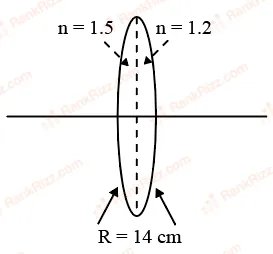
A bi-convex lens is formed with two thin plano-convex lenses as shown in the figure. Refractive index n of the first lens is 1.5 and that of the second lens is 1.2. Both the curved surfaces are of the same radius of curvature R = 14 cm. For this bi-convex lens, for an object distance of 40 cm, the image distance will be

Figure for JEE Advanced 2012 Physics question on Combinations of lenses and mirrors
  1. A

    -280.0 cm.

  2. B

    40.0 cm.

  3. C

    21.5 cm.

  4. D

    13.3 cm.

JEE ADVANCED 2012 · PAPER 2Prism: deviation and dispersionTRANSCRIBED

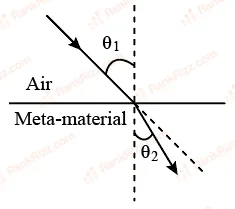
Choose the correct statement.

  1. A

    The speed of light in the meta-material is v=c∣n∣v = c \mid n \mid

  2. B

    The speed of light in the meta-material is v=c∣n∣v = \frac{c}{\mid n \mid}

  3. C

    The speed of light in the meta-material is v = c.

  4. D

    The wavelength of the light in the meta-material (λm)(\lambda_m) is given by λm=λair∣n∣\lambda_m = \lambda_{air} \mid n \mid, where λair\lambda_{air} is the wavelength of the light in air

JEE ADVANCED 2012 · PAPER 2Prism: deviation and dispersionTRANSCRIBED

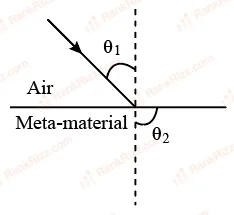
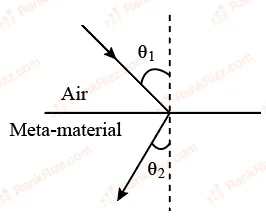
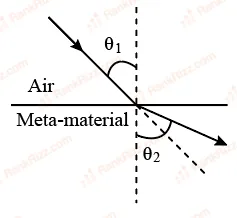
For light incident from air on a meta-material, the appropriate ray diagram is :

  1. A
    Figure for JEE Advanced 2012 Physics question on Prism: deviation and dispersion
  2. B
    Figure for JEE Advanced 2012 Physics question on Prism: deviation and dispersion
  3. C
    Figure for JEE Advanced 2012 Physics question on Prism: deviation and dispersion
  4. D
    Figure for JEE Advanced 2012 Physics question on Prism: deviation and dispersion
JEE ADVANCED 2011 · PAPER 2Prism: deviation and dispersionTRANSCRIBED

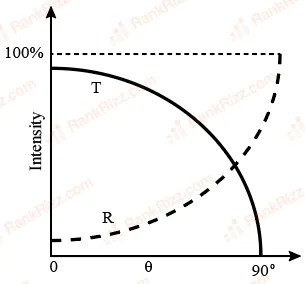
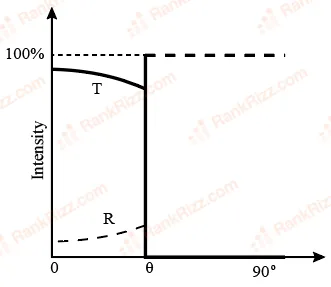
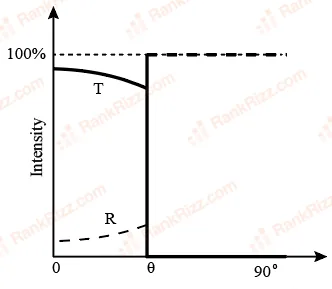
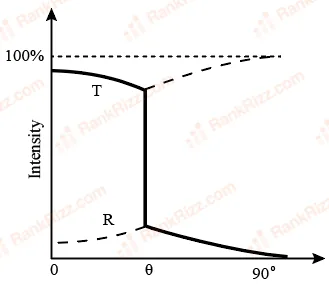
A light ray traveling in glass medium is incident on glass-air interface at an angle of incidence θ\theta. The reflected ( R ) and transmitted ( T ) intensities, both as function of θ\theta, are plotted. The correct sketch is

  1. A
    Figure for JEE Advanced 2011 Physics question on Prism: deviation and dispersion
  2. B
    Figure for JEE Advanced 2011 Physics question on Prism: deviation and dispersion
  3. C
    Figure for JEE Advanced 2011 Physics question on Prism: deviation and dispersion
  4. D
    Figure for JEE Advanced 2011 Physics question on Prism: deviation and dispersion
JEE ADVANCED 2011 · PAPER 2Prism: deviation and dispersionTRANSCRIBED

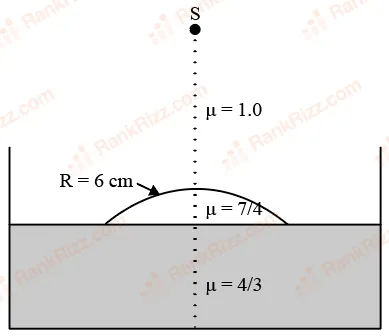
Water (with refractive index = 43\frac{4}{3}) in a tank is 18 cm deep. Oil of refractive index 74\frac{7}{4} lies on water making a convex surface of radius of curvature ‘R = 6 cm’ as shown. Consider oil to act as a thin lens. An object ‘S’ is placed 24 cm above water surface. The location of its image is at ‘x’ cm above the bottom of the tank. Then ‘x’ is

Figure for JEE Advanced 2011 Physics question on Prism: deviation and dispersion
JEE ADVANCED 2010 · PAPER 2Combinations of lenses and mirrorsTRANSCRIBED

A biconvex lens of focal length 15 cmis in front of a plane mirror. The distance between the lens and the mirror is 10 cm. A small object is kept at a distance of 30 cm from the lens. The final image is

  1. A

    virtual and at a distance of 16 cm from the mirror

  2. B

    real and at a distance of 16 cm from the mirror

  3. C

    virtual and at a distance of 20 cm from the mirror

  4. D

    real and at a distance of 20 cm from the mirror

JEE ADVANCED 2010 · PAPER 2Reflection and plane mirrorsTRANSCRIBED

Image of an object approaching a convex mirror of radius of curvature 20 m along its optical axis is observed to move from 253m\frac{25}{3} m to 507m\frac{50}{7} m in 30 seconds. What is the speed of the object in km per hour ?

JEE ADVANCED 2010 · PAPER 2Prism: deviation and dispersionTRANSCRIBED

A large glass slab (μ=53)(\mu = \frac{5}{3}) of thickness 8 cm is placed over a point source of light on a plane surface. It is seen that light emerges out of the top surface of the slab from a circular area of radius R cm. What is the value of R?

JEE ADVANCED 2010 · PAPER 2Combinations of lenses and mirrorsTRANSCRIBED

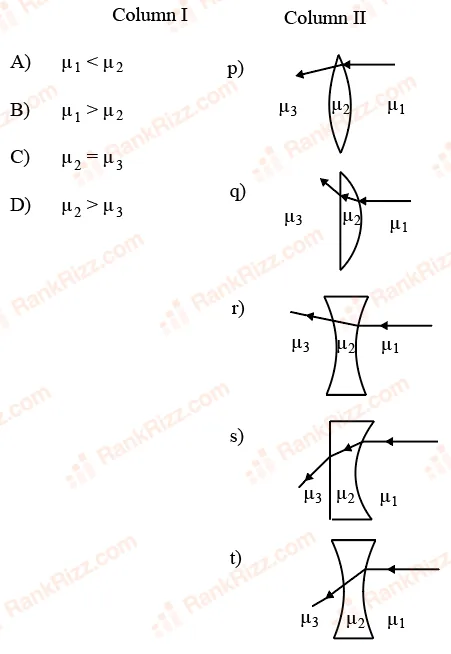
Two transparent media of refractive indices μ1\mu_1 and μ2\mu_2 have a solid lens shaped transper material of refractive index μ2\mu_2 between them as shown in figures in Column II A: traversing these media is also shown in the figures. In Column different relations between μ1,μ2\mu_1, \mu_2 and μ3\mu_3 are given. Match them to the ray diagrams shown in Column

Figure for JEE Advanced 2010 Physics question on Combinations of lenses and mirrors
JEE ADVANCED 2010 · PAPER 1Prism: deviation and dispersionTRANSCRIBED

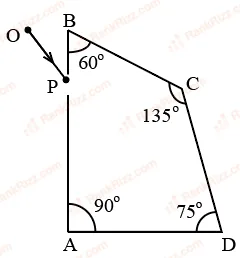
A ray OP of monochromatic light is incident on the face AB of prism ABCD near vertex B at an incident angle of 60∘60^\circ (see figure). If the refractive index of the material of the prism is 3\sqrt{3}, which of the following is (are) correct ?

Figure for JEE Advanced 2010 Physics question on Prism: deviation and dispersion
  1. A

    The raygets totally internally reflected at face CD

  2. B

    The ray comes out through face AD

  3. C

    The angle between the incident ray and the emergent ray is 90∘90^\circ

  4. D

    The angle between the incident ray and the emergent ray is 120∘120^\circ

JEE ADVANCED 2010 · PAPER 1Combinations of lenses and mirrorsTRANSCRIBED

The focal length of a thin biconvex lens is 20cm. When anobject is moved from a distance of 25cmin front of it to 50cm, the magnification of its image changes from m25m_{25} to m50m_{50}. The ratio m25m50\frac{m_{25}}{m_{50}} is

JEE ADVANCED 2009 · PAPER 1Prism: deviation and dispersionTRANSCRIBED

A ball is dropped from a height of 20 m above the surface of water in a lake. The refractive index of water is 43\frac{4}{3}. A fish inside the lake, in the line of fall of the ball, is looking at the ball. At an instant, when the ball is 12.8 m above the water surface, the fish sees the speed of ball as-

  1. A

    9 m/s

  2. B

    12 m/s

  3. C

    16 m/s

  4. D

    21.33 m/s

JEE ADVANCED 2009 · PAPER 1Reflection and plane mirrorsTRANSCRIBED

A student performed the experiment of determination of focal length of a concave mirror by u-v method using an optical bench of length 1.5 meter. The focal length of the mirror used is 24 cm. The maximum error in the location of the image can be 0.2 cm. The 5 sets of (u, v) values recorded by the student (in cm) are : (42, 56), (48, 48), (60, 40), (66, 33), (78, 39). The data set(s) that cannot come from experiment and is(are) incorrectly recorded, is (are)

  1. A

    (42, 56)

  2. B

    (48, 48)

  3. C

    (66, 33)

  4. D

    (78, 39)

JEE ADVANCED 2008 · PAPER 1Prism: deviation and dispersionTRANSCRIBED

Two beams of red and violet colours are made to pass separately through a prism (angle of the prism is 60∘60^\circ). In the position of minimum deviation, the angle of refraction will be

  1. A

    30∘30^\circ for both the colours

  2. B

    greater for the violet colour

  3. C

    greater for the red colour

  4. D

    equal but not 30∘30^\circ for both the colours

JEE ADVANCED 2008 · PAPER 2Prism: deviation and dispersionTRANSCRIBED

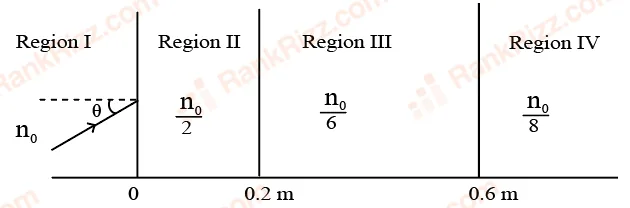
A light beam is traveling from Region I to Region IV (Refer Figure). The refractive index in Regions I, II, III and IV are n0,n02,n06n_0, \frac{n_0}{2}, \frac{n_0}{6} and n08\frac{n_0}{8}, respectively. The angle of incidence θ\theta for which the beam just misses entering Region IV is 

Figure for JEE Advanced 2008 Physics question on Prism: deviation and dispersion
  1. A

    sin⁡−1(34)\sin^{-1}\left(\frac{3}{4}\right)

  2. B

    sin⁡−1(18)\sin^{-1}\left(\frac{1}{8}\right)

  3. C

    sin⁡−1(14)\sin^{-1}\left(\frac{1}{4}\right)

  4. D

    sin⁡−1(13)\sin^{-1}\left(\frac{1}{3}\right)

JEE ADVANCED 2008 · PAPER 2Combinations of lenses and mirrorsTRANSCRIBED

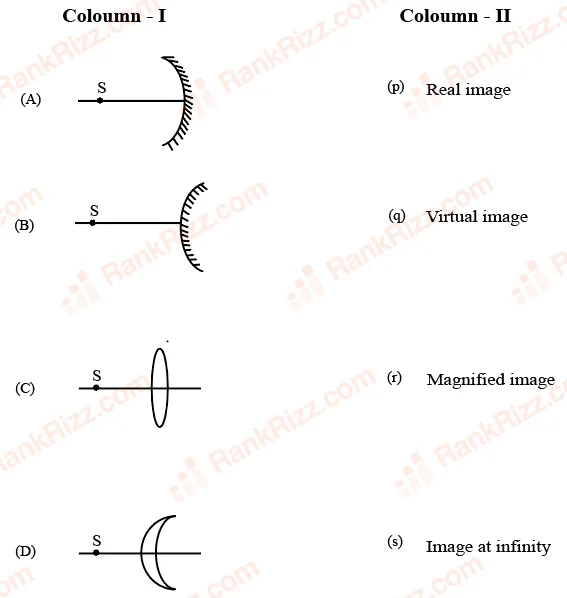
An optical component and an object S placed along its optic axis are given in Column I. The distance between the object and the component can be varied. The properties of images are given in Column II. Match all the properties of images from Column II with the appropriate components given in Column I. Indicate your answer by darkening the appropriate bubbles of the 4×44 \times 4 matrix given in the ORS.

Figure for JEE Advanced 2008 Physics question on Combinations of lenses and mirrors
JEE ADVANCED 2007 · PAPER 1Reflection and plane mirrorsTRANSCRIBED

In an experiment to determine the focal length (f) of a concave mirror by the u-v method, a student places the object pin A on the principal axis at a distance x from the pole P. The student looks at the pin and its inverted image from a distance keeping his/her eye in line with PA. When the student shifts his/her eye towards left, the image appears to the right of the object pin. Then,

  1. A

    x < f

  2. B

    f < x < 2f

  3. C

    x = 2f

  4. D

    x > 2f

JEE ADVANCED 2007 · PAPER 1Prism: deviation and dispersionTRANSCRIBED

A ray of light traveling in wateris incident on its surface open to air. The angle of incidence is θ\theta, which is less than the critical angle. Then there will be

  1. A

    only reflected ray and no refracted ray

  2. B

    only a refracted ray and no reflected ray

  3. C

    a reflected ray and a refracted ray and the angle between them would be less than 180∘−2θ180^\circ - 2\theta

  4. D

    a reflected ray and a refracted ray and the angle between them would be greater than 180∘−2θ180^\circ - 2\theta