JEE Advanced 2014 Physics question — Combinations of lenses and mirrors
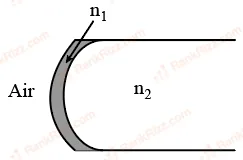
A transparent thin film of uniform thickness and refractive index is coated on the convex spherical surface of radius Rat one end of a long solid glass cylinder of refractive index as shown in the figure. Rays of light parallel to the axis of the cylinder traversing through the film from air to glass get focused at distance from the film, while rays of light traversing from glass to air get focused at distance from the film. Then
SOLUTION
Key idea: A thin film of uniform thickness hardly bends the rays, so the system behaves like a single air–glass () spherical surface of radius . The surface is convex towards the air.
Use .
- Air to glass (parallel rays, , ):
- Glass to air (parallel rays inside the glass travelling towards the surface; the centre of curvature is now on the incident side, so ):
Answer: (A), (C)
Tagged Combinations of lenses and mirrors. Machine-assigned, so read it as a strong shortlist rather than a verdict.