JEE Advanced 2025 Physics question — Hydrogen spectrum and spectral series
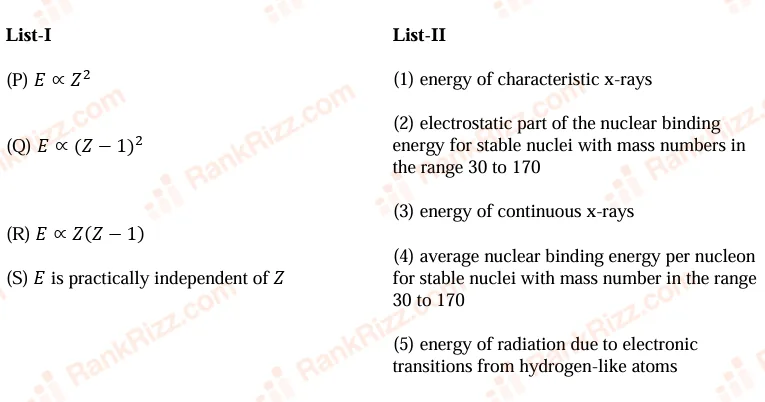
List-I shows various functional dependencies of energy () on the atomic number (). Energies associated with certain phenomena are given in List-II.
Choose the option that describes the correct match between the entries in List-I to those in List-II.
SOLUTION
The question gives four different proportionalities of energy with atomic number (List-I) and asks us to match them with the physical phenomena listed in List-II. We discuss each proportionality one by one.
Case P :For a hydrogen-like (one-electron) ion with nuclear charge , the Bohr model gives the energy of the orbit as Hence the energy difference between any two levels, and therefore the photon energy emitted during an electronic transition, is proportional to . This exactly matches List-II entry (5) “energy of radiation due to electronic transitions from hydrogen-like atoms”.
Therefore, .
Case Q :Moseley’s law for characteristic X-rays (for example, Kα, Kβ lines) is so the photon energy also follows . The factor accounts for the screening of one inner-shell electron.
Thus, corresponding to “energy of characteristic X-rays”.
Case R :In the semi-empirical mass formula, the electrostatic (Coulomb) part of the nuclear binding energy is For medium-mass stable nuclei (), is roughly proportional to , so apart from a slowly varying denominator, the numerator gives the leading dependence .
Hence, “electrostatic part of the nuclear binding energy for stable nuclei with mass numbers in the range 30 to 170”.
Case S : almost independent ofThe average binding energy per nucleon for medium-mass stable nuclei (say ) is nearly constant at about and shows only a very weak dependence on .
This matches List-II entry (4) “average nuclear binding energy per nucleon for stable nuclei with mass number in the range 30 to 170”. Therefore, .
Collecting all the matches:
This set of correspondences is given by Option C.
Tagged Hydrogen spectrum and spectral series. Machine-assigned, so read it as a strong shortlist rather than a verdict.