RankRizz

Atoms & Nuclei — JEE Advanced Previous Year Questions

Every Atoms & Nuclei question JEE Advanced has set from 2007–2026, grouped by the idea it tests rather than the order of the syllabus. 53 questions across 6 distinct ideas. Free to read, answer key on every one.

Questions

53

Distinct ideas

6

Share of marks

6%

Difficulty

EASY

The ideas inside Atoms & Nuclei

A chapter is not one subject — it is a handful of procedures the examiner reuses. These are the ones Atoms & Nuclei questions actually test.

01Alpha-particle scattering and Rutherford modelNot set in Advanced
02Bohr model of hydrogen-like atomsset 1×
03Hydrogen spectrum and spectral seriesset 17×
04X-rays: continuous and characteristic spectra, Moseley's lawset 2×
05Nuclear size, mass defect and binding energyset 1×
06Nuclear fission, fusion and Q-valueset 12×
07Radioactivity: decay law, half-life and decay modesset 20×

Every Atoms & Nuclei question

21–40 OF 53 · NEWEST FIRST

JEE ADVANCED 2016 · PAPER 2Radioactivity: decay law, half-life and decay modesTRANSCRIBED

An accident in a nuclear laboratory resulted in deposition of a certain amount of radioactive material of half-life 18 days inside the laboratory. Tests revealed that the radiation was 64 times more than the permissible level required for safe operation of the laboratory. What is the minimum number of days after which the laboratory can be considered safe for use?

  1. A

    64

  2. B

    90

  3. C

    108

  4. D

    120

JEE ADVANCED 2016 · PAPER 1Hydrogen spectrum and spectral seriesTRANSCRIBED

Highly excited states for hydrogen-like atoms (also called Rydberg states) with nuclear charge Ze are defined by their principal quantum number n, where n >> 1. Which of the
following statement(s) is(are) true?

  1. A

    Relative change in the radii of two consecutive orbitals does not depend on Z

  2. B

    Relative change in the radii of two consecutive orbitals varies as 1n\frac{1}{n}

  3. C

    Relative change in the energy of two consecutive orbitals varies as 1n3\frac{1}{n^3}

  4. D

    Relative change in the angular momenta of two consecutive orbitals varies as 1n\frac{1}{n}

JEE ADVANCED 2016 · PAPER 1Nuclear fission, fusion and Q-valueTRANSCRIBED

The isotope 512B_{5}^{12}B having a mass 12.014 u undergoes β\beta- decay to 612C_{6}^{12}C, 612C_{6}^{12}C has an excited state of the nucleus (612C∗_{6}^{12}C^*) at 4.041 MeV above its ground state. If 512B_{5}^{12}B decays to 612C∗_{6}^{12}C^*, the maximumkinetic energy of the β\beta- particle in units of MeV is
(1 u = 931.5 MeV/c2^2, where c is the speed of light in vacuum).

JEE ADVANCED 2016 · PAPER 1Hydrogen spectrum and spectral seriesTRANSCRIBED

A hydrogen atom in its ground state is irradiated by light of wavelength 970 A. Taking hc/e=1.237×10−6eVhc/e = 1.237 \times 10^{-6} eV m and the ground state energy of hydrogen atom as —13.6 eV, the numberof lines present in the emission spectrum is

JEE ADVANCED 2015 · PAPER 1Hydrogen spectrum and spectral seriesTRANSCRIBED

Consider a hydrogen atom with its electron in the nthn^{th} orbital. An electromagnetic radiation of wavelength 90 nm is used to ionize the atom. If the kinetic energy of the ejected electron is 10.4 eV, then the value of n is (hc = 1242 eV nm)

JEE ADVANCED 2015 · PAPER 2Radioactivity: decay law, half-life and decay modesTRANSCRIBED

For a radioactive material, its activity A and rate of change of its activity R are defined as A=−dNdtA = - \frac{dN}{dt} and R=−dAdt,R = - \frac{dA}{dt}, where N(t) is the number of nuclei at time t. Two radioactive sources P (mean life τ\tau) and Q (mean life 2τ2\tau) have the same activity at t = 0. Their rates of change of activities at t=2τt = 2\tau are RPR_P and RQR_Q, respectively. If RPRQ=ne,\frac{R_P}{R_Q} = \frac{n}{e}, then the value of n is

JEE ADVANCED 2015 · PAPER 1Radioactivity: decay law, half-life and decay modesTRANSCRIBED

A nuclear power plant supplying electrical power to a village uses a radioactive material of half life 7’ years as the fuel. The amountof fuel at the beginningis such that the total power requirement of the village is 12.5% of the electrical power available from the plant at that time. If the plant is able to meet the total power needsof the village for a maximum period of nT years, then the valueof n is

JEE ADVANCED 2015 · PAPER 2Nuclear fission, fusion and Q-valueTRANSCRIBED

A fission reaction is given by 92236U→54140Xe+3894Sr+x+y_{92}^{236}U \rightarrow _{54}^{140}Xe + _{38}^{94}Sr + x + y where x and y are two particles. Considering 92236U_{92}^{236}U to be at rest, the kinetic energies of the products are denoted by KXe,KSr,Kx(2MeV)K_{Xe}, K_{Sr}, K_x (2 MeV) and Ky(2MeV),K_y (2 MeV), respectively. Let the binding energies per nucleon of 92236U,54140Xe_{92}^{236}U, _{54}^{140}Xe and 3894Sr_{38}^{94}Sr be 7.5 MeV, 8.5 MeV and 8.5 MeV,respectively. Considering different conservation laws, the correct option(s) is(are)

  1. A

    x=n,y=n,KSr=129MeV,KXe=86MeVx = n, y = n, K_{Sr} = 129 MeV, K_{Xe} = 86 MeV

  2. B

    x=p,y=e−,KSr=129MeV,KXe=86MeVx = p, y = e^-, K_{Sr} = 129 MeV, K_{Xe} = 86 MeV

  3. C

    x=p,y=n,KSr=129MeV,KXe=86MeVx = p, y = n, K_{Sr} = 129 MeV, K_{Xe} = 86 MeV

  4. D

    x=n,y=n,KSr=86MeV,KXe=129MeVx = n, y = n, K_{Sr} = 86 MeV, K_{Xe} = 129 MeV

JEE ADVANCED 2015 · PAPER 1Nuclear fission, fusion and Q-valueTRANSCRIBED

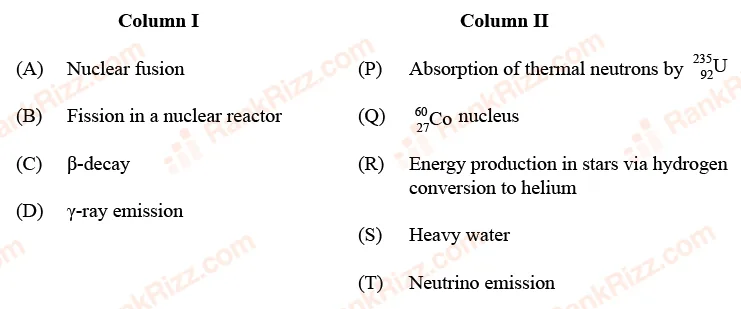
Match the nuclear processes given in column I with the appropriate option(s) in column II.

Figure for JEE Advanced 2015 Physics question on Nuclear fission, fusion and Q-value
JEE ADVANCED 2014 · PAPER 2X-rays: continuous and characteristic spectra, Moseley's lawTRANSCRIBED

If λCu\lambda_{Cu} is the wavelength of KαK_{\alpha} X-ray line of copper (atomic number 29) and λMo\lambda_{Mo} is the wavelength of the KαK_{\alpha} X-ray line of molybdenum (atomic number 42), then the ratio λCuλMo\frac{\lambda_{Cu}}{\lambda_{Mo}}is close to

  1. A

    1.99

  2. B

    2.14

  3. C

    0.50

  4. D

    0.48

JEE ADVANCED 2013 · PAPER 2Hydrogen spectrum and spectral seriesTRANSCRIBED

The radius of the orbit of an electron in a Hydrogen-like atom is 4.5 a0a_0, where a0a_0 is the bohr radius. Its orbital angular momentum is 3h2π\frac{3h}{2 \pi}. It is given that h is Planck constant and R is Rydberg constant. The possible wavelength(s), when the atom de-excites, is (are)

  1. A

    932R\frac{9}{32 R}

  2. B

    916R\frac{9}{16 R}

  3. C

    95R\frac{9}{5 R}

  4. D

    43R\frac{4}{3 R}

JEE ADVANCED 2013 · PAPER 2Nuclear fission, fusion and Q-valueTRANSCRIBED

The correct statement is

  1. A

    The nucleus 36Li^6_3Li can emit an alpha particle.

  2. B

    The nucleus 84210Po^{210}_{84}Po can emit a proton.

  3. C

    Deuteron and alpha particle can undergo complete fusion.

  4. D

    The nuclei 3070Zn^{70}_{30}Zn and 3482Se^{82}_{34}Se can undergo complete fusion

JEE ADVANCED 2013 · PAPER 2Radioactivity: decay law, half-life and decay modesTRANSCRIBED

The kinetic energy (in keV) of the alpha particle, when the nucleus 84210Po^{210}_{84}Po at rest undergoes alpha decay, is

  1. A

    5319

  2. B

    5422

  3. C

    5707

  4. D

    5818

JEE ADVANCED 2013 · PAPER 1Radioactivity: decay law, half-life and decay modesTRANSCRIBED

A freshly prepared sample of a radioisotope of half-life 1386 s has activity 10310^3 disintegrations per second. Given that ln 2 = 0.693, the fraction of the initial number of nuclei (expressed in nearest integer percentage) that will decay in the first 80 s after preparation of the sample is

JEE ADVANCED 2013 · PAPER 2Radioactivity: decay law, half-life and decay modesTRANSCRIBED

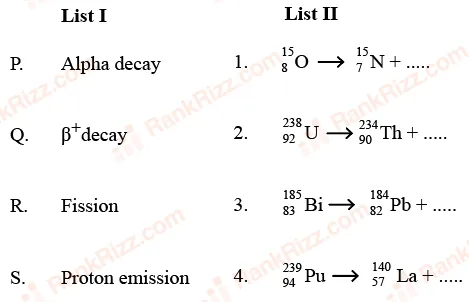
Match List I of the nuclear processes with List II containing parent nucleus and one of the end products of each process and then select the correct answer using the codes given below the lists :

Figure for JEE Advanced 2013 Physics question on Radioactivity: decay law, half-life and decay modes
  1. A

    P-4, Q-2, R-1, S-3

  2. B

    P-1, Q-3, R-2, S-4

  3. C

    P-2, Q-1, R-4, S-3

  4. D

    P-4, Q-3, R-2, S-1

JEE ADVANCED 2012 · PAPER 2Radioactivity: decay law, half-life and decay modesTRANSCRIBED

What is the maximum energy of the anti-neutrino ?

  1. A

    Zero

  2. B

    Much less than 0.8×1060.8 \times 10^6 eV

  3. C

    Nearly 0.8×1060.8 \times 10^6 eV

  4. D

    Much larger than 0.8×1060.8 \times 10^6 eV

JEE ADVANCED 2012 · PAPER 2Nuclear fission, fusion and Q-valueTRANSCRIBED

If the anti-neutrino had amass of 3 eV/c2^2 (where c is the speed of light) instead of zeromass, what should be the range of the kinetic energy, K, of the electron ?

  1. A

    0≤K≤0.8×1060 \leq K \leq 0.8 \times 10^6eV

  2. B

    3.0 eV ≤K≤0.8×10⁶\leq K \leq 0.8 \times 10^6eV

  3. C

    3.0 eV ≤K<0.8×10⁶\leq K < 0.8 \times 10^6eV

  4. D

    0≤K<0.8×1060 \leq K < 0.8 \times 10^6eV

JEE ADVANCED 2011 · PAPER 1Hydrogen spectrum and spectral seriesTRANSCRIBED

The wavelength of the first spectral line in the Balmer series of hydrogen atom is 6561 Å. The wave length of the second spectral line in the Balmer series of singly-ionized helium atom is-

  1. A

    1215 Å

  2. B

    1640 Å

  3. C

    2430 Å

  4. D

    4687 Å

JEE ADVANCED 2011 · PAPER 1Radioactivity: decay law, half-life and decay modesTRANSCRIBED

The activity of a freshly prepared radioactive sample is 101010^{10} disintegrations per second, whose mean life is 10910^{9} s. The mass of an atom of this radioisotope is 10−2510^{-25} kg. The mass (in mg) of the radioactive sample is.

JEE ADVANCED 2010 · PAPER 2Radioactivity: decay law, half-life and decay modesTRANSCRIBED

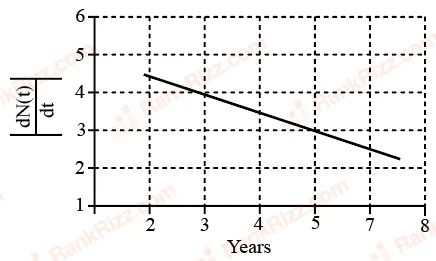
To determine the half life of a radioactive element, a student plots a graph of ln⁡∣dN(t)dt∣\ln \mid \frac{dN(t)}{dt} \mid versus t. Here dN(t)dt\frac{dN(t)}{dt} is the rate of radioactive decay at time t If the number of radioactive nuclei of this element decreases by a factor of p after 4.16 years, the value of p is

Figure for JEE Advanced 2010 Physics question on Radioactivity: decay law, half-life and decay modes