JEE Advanced 2025 Chemistry question — Group analysis and confirmatory tests of cations
The correct match of the group reagents in List-I for precipitating the metal ion given in List-II from solutions, is
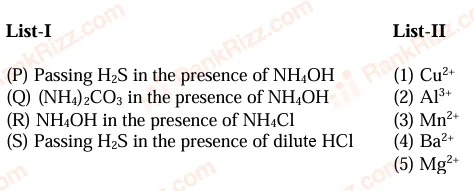
SOLUTION
In qualitative inorganic analysis, cations are separated into groups by adding specific group reagents. Each reagent precipitates only those ions whose analytical product (sulfide, hydroxide, carbonate, etc.) has a very low solubility under the given conditions. We first recall the standard group scheme:
• Group II reagent : pass in dilute (acidic medium) precipitates insoluble sulfides such as …
• Group III reagent : add in the presence of excess (buffered weakly basic) precipitates gelatinous hydroxides …
• Group IV reagent : pass in basic medium (presence of ) precipitates the less‐insoluble sulfides …
• Group V reagent : add in presence of precipitates carbonates of alkaline-earth metals …
Now match each List-I reagent with the metal ion of List-II whose salt is precipitated by that reagent.
Case P:Reagent : pass in presence of (alkaline) Group IV.
Among the given ions, forms the insoluble sulfide under these conditions.
Hence P 3 ().
Reagent : in presence of Group V.
Of the listed ions, is an alkaline-earth metal and is precipitated as .
Hence Q 4 ().
Reagent : with buffer Group III.
This reagent precipitates trivalent hydroxides; gives .
Hence R 2 ().
Reagent : pass in dilute (acidic) Group II.
is a typical group-II cation, precipitated as black .
Hence S 1 ().
Collecting the matches: P 3, Q 4, R 2, S 1.
Therefore the correct option is:
Option A which is: P 3; Q 4; R 2; S 1.
Tagged Group analysis and confirmatory tests of cations. Machine-assigned, so read it as a strong shortlist rather than a verdict.