RankRizz

p-Block Elements: Groups 15 to 18 — JEE Advanced Previous Year Questions

Every p-Block Elements: Groups 15 to 18 question JEE Advanced has set from 2007–2026, grouped by the idea it tests rather than the order of the syllabus. 54 questions across 8 distinct ideas. Free to read, answer key on every one.

Questions

54

Distinct ideas

8

Share of marks

7.4%

Difficulty

EASY

The ideas inside p-Block Elements: Groups 15 to 18

A chapter is not one subject — it is a handful of procedures the examiner reuses. These are the ones p-Block Elements: Groups 15 to 18 questions actually test.

01Group 15: trends and hydridesset 4×
02Dinitrogen, ammonia, nitric acid and oxides of nitrogenset 2×
03Phosphorus and its compoundsset 24×
04Group 16: trends, dioxygen, ozone and oxidesset 1×
05Sulphur and its compoundsset 3×
06Group 17: halogens and hydrogen halidesset 3×
07Oxoacids of halogens and interhalogen compoundsset 10×
08Group 18: noble gases and xenon compoundsset 7×

Every p-Block Elements: Groups 15 to 18 question

21–40 OF 54 · NEWEST FIRST

JEE ADVANCED 2018 · PAPER 1Phosphorus and its compoundsTRANSCRIBED

Based on the compounds of group 15 elements, the correct statement(s) is (are)

  1. A

    Bi2O5Bi_{2}O_{5} is more basic than N2O5N_{2}O_{5}

  2. B

    NF3NF_{3} is more covalent than BF3BF_{3}

  3. C

    PH3PH_{3} boils at lower temperature than NH3NH_{3}

  4. D

    The N−N single bond is stronger than the P−P single bond
JEE ADVANCED 2017 · PAPER 1Oxoacids of halogens and interhalogen compoundsTRANSCRIBED

The correct statement(s) about the oxoacids, HClO4HClO_4 and HClOHClO, is(are)

  1. A

    The central atom in both HClO4HClO_4 and HClOHClO is sp3sp^3 hybridized

  2. B

    HClO4HClO_4 is more acidic than HClOHClO because of the resonance stabilization of its anion

  3. C

    HClO4HClO_4 is formed in the reaction between Cl2Cl_2 and H2OH_2O

  4. D

    The conjugate base of HClO4HClO_4 is weaker base than H2OH_2O

JEE ADVANCED 2017 · PAPER 1Oxoacids of halogens and interhalogen compoundsTRANSCRIBED

The colour of the X2X_2 molecules of group 17 elements changes gradually from yellow to violet down the group. This is due to

  1. A

    the physical state of X2X_2 at room temperature changes from gas to solid down the group

  2. B

    decrease in ionization energy down the group

  3. C

    decrease in π∗−σ∗\pi^* - \sigma^* gap down the group

  4. D

    decrease in HOMO-LUMO gap down the group

JEE ADVANCED 2017 · PAPER 2Phosphorus and its compoundsTRANSCRIBED

W and X are, respectively

  1. A

    O3O_{3} and P4O6P_{4}O_{6}

  2. B

    O2O_{2} and P4O6P_{4}O_{6}

  3. C

    O2O_{2} and P4O10P_{4}O_{10}

  4. D

    O3O_{3} and P4O10P_{4}O_{10}

JEE ADVANCED 2017 · PAPER 2Phosphorus and its compoundsTRANSCRIBED

Y and Z are, respectively

  1. A

    N2O3N_{2}O_{3} and H3PO4H_{3}PO_{4}

  2. B

    N2O5N_{2}O_{5} and HPO3HPO_{3}

  3. C

    N2O4N_{2}O_{4} and HPO3HPO_{3}

  4. D

    N2O4N_{2}O_{4} and H3PO3H_{3}PO_{3}

JEE ADVANCED 2016 · PAPER 2Phosphorus and its compoundsTRANSCRIBED

The nitrogen containing compound producedin the reaction of HNO3HNO_3 with P4O10P_4O_{10}

  1. A

    can also be prepared by reaction of P4P_4 and HNO3HNO_3

  2. B

    is diamagnetic

  3. C

    contains one N-N bond

  4. D

    reacts with Na metal producing a brown gas

JEE ADVANCED 2015 · PAPER 1Phosphorus and its compoundsTRANSCRIBED

The total number of lone pairs of electrons in N2O3N_2O_3 is

JEE ADVANCED 2015 · PAPER 2Oxoacids of halogens and interhalogen compoundsTRANSCRIBED

The correct statement(s) regarding, (i)HClO,(ii)HClO2(iii)HClO3(i) HClO, (ii) HClO_2 (iii) HClO_3 and (iv)HClO4(iv) HClO_4 is(are)

  1. A

    The numberof Cl = O bonds in (ii) and (iii) together is two

  2. B

    The number of lone pairs of electrons on Cl in (ii) and(iii) together is three

  3. C

    The hybridization of Cl in (iv) is sp3sp^3

  4. D

    Amongst(i) to (iv), the strongest acid is(i)

JEE ADVANCED 2014 · PAPER 2Phosphorus and its compoundsTRANSCRIBED

The product formed in the reaction of SOCl2SOCl_2 with white phosphorous is

  1. A

    PCl3PCl_3

  2. B

    SO2Cl2SO_2Cl_2

  3. C

    SCl2SCl_2

  4. D

    POCl3POCl_3

JEE ADVANCED 2014 · PAPER 2Group 18: noble gases and xenon compoundsTRANSCRIBED

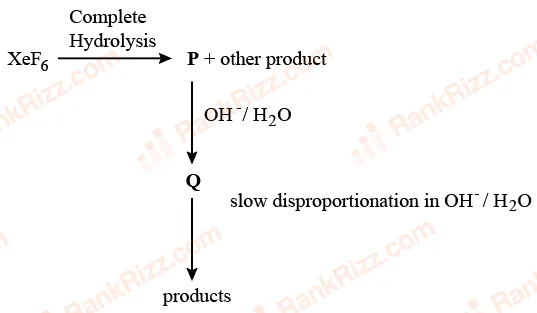
Under ambient conditions, the total number of gases released as products in the final step of the reaction scheme shown below is

Figure for JEE Advanced 2014 Chemistry question on Group 18: noble gases and xenon compounds
  1. A

    0

  2. B

    1

  3. C

    2

  4. D

    3

JEE ADVANCED 2013 · PAPER 2Sulphur and its compoundsTRANSCRIBED

The correct statement(s) about O3O_{3} is(are)

  1. A

    O−OO-O bond lengths are equal.

  2. B

    Thermal decomposition of O3O_{3} is endothermic.

  3. C

    O3O_{3} is diamagnetic in nature.

  4. D

    O3O_{3} has a bentstructure.

JEE ADVANCED 2013 · PAPER 1Phosphorus and its compoundsTRANSCRIBED

Concentrated nitric acid, upon long standing, turns yellow-brown due to the formation of

  1. A

    NONO

  2. B

    NO2NO_2

  3. C

    N2ON_2O

  4. D

    N2O4N_2O_4

JEE ADVANCED 2013 · PAPER 2Oxoacids of halogens and interhalogen compoundsTRANSCRIBED

P and Q,respectively, are the sodium salts of

  1. A

    hypochlorus and chloric acids

  2. B

    hypochlorus and chlorus acids

  3. C

    chloric and perchloric acids

  4. D

    chloric and hypochlorus acids

JEE ADVANCED 2013 · PAPER 2Oxoacids of halogens and interhalogen compoundsTRANSCRIBED

R, S and T, respectively, are

  1. A

    SO2Cl2,PCl5SO_{2}Cl_{2},PCl_{5} and H3PO4H_{3}PO_{4}

  2. B

    SO2Cl2,PCl3SO_{2}Cl_{2},PCl_{3} and H3PO3H_{3}PO_{3}

  3. C

    SOCl2,PCl3SOCl_{2},PCl_{3} and H3PO2H_{3}PO_{2}

  4. D

    SOCl2,PCl5SOCl_{2},PCl_{5} and H3PO4H_{3}PO_{4}

JEE ADVANCED 2013 · PAPER 2Oxoacids of halogens and interhalogen compoundsTRANSCRIBED

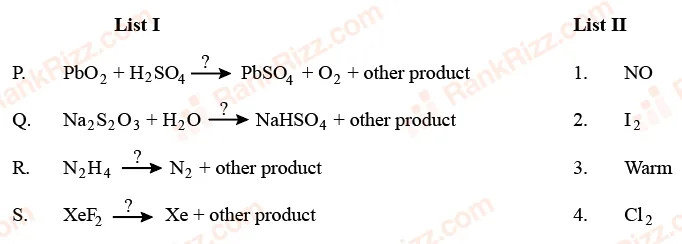
The unbalanced chemical reactions given in List I show missing reagent or condition (?) which are provided in List II. Match List I with List Il and select the correct answer using the code given below the lists :

Figure for JEE Advanced 2013 Chemistry question on Oxoacids of halogens and interhalogen compounds
  1. A

    P-4, Q-2, R-3, S-1

  2. B

    P-3, Q-2, R-1, S-4

  3. C

    P-1, Q-4, R-2, S-3

  4. D

    P-3, Q-4, R-2, S-1

JEE ADVANCED 2012 · PAPER 2Phosphorus and its compoundsTRANSCRIBED

The reaction of white phosphorous with aqueous NaOH gives phosphine along with another phosphorus containing compound. The reaction type; the oxidation states of phosphorous in phosphine and the other product are respectively

  1. A

    redox reaction; -3 and -5

  2. B

    redox reaction; 3 and +5

  3. C

    disproportionation reaction ; -3 and +5

  4. D

    disproportionation reaction ; -3 and +3

JEE ADVANCED 2012 · PAPER 1Phosphorus and its compoundsTRANSCRIBED

Which ordering of compoundsis according to the decreasing order of the oxidation state of nitrogen?

  1. A

    HNO3,NO,NH4Cl,N2HNO_3, NO, NH_4Cl, N_2

  2. B

    HNO3,NO,N2,NH4ClHNO_3, NO, N_2, NH_4Cl

  3. C

    HNO3,NH4Cl,NO,N2HNO_3, NH_4Cl, NO, N_2

  4. D

    NO,HNO3,NH4Cl,N2NO, HNO_3, NH_4Cl, N_2

JEE ADVANCED 2012 · PAPER 2Oxoacids of halogens and interhalogen compoundsTRANSCRIBED

25mL of household bleach solution was mixed with 30mL of 0.50MKI and 10mL of 4N acetic acid. In the titration of the liberated iodine, 48mL of 0.25 N Na2S2O3Na_2S_2O_3 was used to reach the end point. Themolarity of the household bleach solution is

  1. A

    0.48 M

  2. B

    0.96 M

  3. C

    0.24 M

  4. D

    0.024 M

JEE ADVANCED 2012 · PAPER 2Oxoacids of halogens and interhalogen compoundsTRANSCRIBED

Bleaching powder contains a salt of an oxoacid as one of its components. The anhydride of that oxoacid is

  1. A

    Cl2OCl_2O

  2. B

    Cl2O7Cl_2O_7

  3. C

    ClO2ClO_2

  4. D

    Cl2O6Cl_2O_6

JEE ADVANCED 2012 · PAPER 1Oxoacids of halogens and interhalogen compoundsTRANSCRIBED

Which of the following hydrogen halides react(s) with AgNO3(aq)AgNO_3(aq) to give a precipitate that dissolves in Na2S2O3(aq)Na_2S_2O_3(aq)?

  1. A

    HCl

  2. B

    HF

  3. C

    HBr

  4. D

    HI