RankRizz

p-Block Elements: Groups 15 to 18 — JEE Main Previous Year Questions

Every p-Block Elements: Groups 15 to 18 question JEE Main has set from 2004–2026, grouped by the idea it tests rather than the order of the syllabus. 173 questions across 8 distinct ideas. Free to read, answer key on every one.

Questions

173

Distinct ideas

8

Share of marks

2%

Difficulty

EASY

The ideas inside p-Block Elements: Groups 15 to 18

A chapter is not one subject — it is a handful of procedures the examiner reuses. These are the ones p-Block Elements: Groups 15 to 18 questions actually test.

p-Block Elements: Groups 15 to 18 weightage, year by year

The share of each year’s Chemistry questions that came from p-Block Elements: Groups 15 to 18, counted from the 168 papers we hold for the last 10 years, and session by session inside a year.

Falling: 2.3% of Chemistry questions in 2024–2026, down from 3.3% in 2017–2023. Its heaviest year was 2017, at 6.7%.

20269 / 4801.9%JAN 1.6%APR 2.2%
20258 / 4751.7%JAN 1.6%APR 1.8%
202419 / 6003.2%JAN 4.3%APR 2.0%
202318 / 7502.4%JAN 2.6%APR 2.2%
202229 / 6604.4%JUN 4.7%JUL 4.0%
202125 / 7203.5%FEB 2.0%MAR 4.0%JUL 2.9%AUG 4.8%
202013 / 4003.3%JAN 2.7%SEP 3.6%
20198 / 4801.7%JAN 2.1%APR 1.3%
20188 / 1206.7%4 PAPERS, ONE SESSION
20176 / 906.7%3 PAPERS, ONE SESSION

“QS” is p-Block Elements: Groups 15 to 18 questions out of all Chemistry questions that year. A year with more sittings asks more questions, which is why the share, not the count, is the number to compare.

p-Block Elements: Groups 15 to 18: quick answers

How many p-Block Elements: Groups 15 to 18 questions has JEE Main asked?

173 questions from 2004–2026. Over the last 20 papers, p-Block Elements: Groups 15 to 18 carried about 2% of Chemistry marks.

Which p-Block Elements: Groups 15 to 18 topics come up most?

Group 15: trends and hydrides (73 questions), Group 16: trends, dioxygen, ozone and oxides (32 questions), Group 17: halogens and hydrogen halides (28 questions). Start with these, they are what the examiner keeps coming back to.

Is p-Block Elements: Groups 15 to 18 important for JEE Main?

Falling: 2.3% of Chemistry questions in 2024–2026, down from 3.3% in 2017–2023. Its heaviest year was 2017, at 6.7%. It has carried about 2% of Chemistry marks in recent papers, rated easy on our difficulty scale. The year-by-year table above shows how that has moved.

Do these p-Block Elements: Groups 15 to 18 PYQs have answers and solutions?

Yes. Every question shows its official answer key, and a worked solution opens on the question’s own page wherever we have one. Reading and checking answers is free, no sign-up needed.

What’s the fastest way to revise p-Block Elements: Groups 15 to 18?

Do one past question per idea first: p-Block Elements: Groups 15 to 18 has 8 distinct ideas, listed above. Then practise the topics you get wrong, or build a timed test from this chapter.

Every p-Block Elements: Groups 15 to 18 question

1–20 OF 173 · NEWEST FIRST

JEE MAIN 2026 · 22 JAN S2Group 15: trends and hydridesTRANSCRIBED

Given below are two statements:
Statement I : Elements 'X' and 'Y' are the most and least electronegative elements, respectively among N, As, Sb and P. The nature of the oxides X2O3X_{2}O_{3} and y2O3y_{2}O_{3} is acidic and
amphoteric, respectively.
Statement II:BCl3BCl_{3} is covalent in nature and gets hydrolysed in water. It produces [B(OH)4]−[B(OH)_{4}]^{-} and [B(H2O)6]3+[B(H_{2}O)_{6}]^{3+} in aqueous medium.
In the Light of the above statements, choose the correct answer from the options given below:

  1. A

    Both Statement I and Statement II are true

  2. B

    Statement I is false but Statement II is true

  3. C

    Both Statement I and Statement II are false

  4. D

    Statement I is true but Statement II is false
JEE MAIN 2026 · 04 APR S1Group 16: trends, dioxygen, ozone and oxidesTRANSCRIBED

Given below are two statements:
Statement I: The covalency of oxygen is generally two but it can exceed upto four. The oxidation state of oxygen in SO2\text{SO}_2 is −2-2 and in OF2\text{OF}_2 it is +2+2.
Statement II: The anomalous behaviour of oxygen when compared to the other elements of group 16 is due to its small size and high electronegativity.
In the light of the above statements, choose the correct answer from the options given below

  1. A

    Both Statement I and Statement II are true

  2. B

    Both Statement I and Statement II are false

  3. C

    Statement I is true but Statement II is false

  4. D

    Statement I is false but Statement II is true

JEE MAIN 2026 · 05 APR S2Group 17: halogens and hydrogen halidesTRANSCRIBED

Given below are two statements:

Statement I :\textbf{Statement I :} Aluminium upon reaction with NaOH\text{NaOH} forms [Al(OH)6]3−[\text{Al(OH)}_6]^{3-} ion.

Statement II :\textbf{Statement II :} The geometry of ICl4−\text{ICl}_4^{-}, ClO3−\text{ClO}_3^{-} and IBr2−\text{IBr}_2^{-} is square planar, pyramidal and linear respectively.

In the light of the above statements, choose the correct answer from the options given below:

  1. A

    Both statements are true

  2. B

    Both statements are false

  3. C

    Statement I is true but Statement II is false

  4. D

    Statement I is false but Statement II is true

JEE MAIN 2026 · 08 APR S2Group 15: trends and hydridesTRANSCRIBED

Find the correct statements related to group 15 hydrides.
A. Reducing nature increases from NH3_3 to BiH3_3
B. Tendency to donate lone pair of electrons decreases from NH3_3 to BiH3_3
C. The stability of hydrides decreases from NH3_3 to BiH3_3
D. HEH bond angle decreases from NH3_3 to SbH3_3 (E = Elements of group 15)
Choose the correct answer from the options given below :

  1. A

    A and B only

  2. B

    B and C only

  3. C

    A, B, C and D

  4. D

    A, C and D Only

JEE MAIN 2026 · 05 APR S1Group 15: trends and hydridesTRANSCRIBED

Correct statements from the following are:
A. Nitrogen in oxidation states from +1 to +4 disproportionates in acid medium.
B. Nitrogen has the ability to form dπ\pi - pπ\pi multiple bonds with itself and other elements with small size and high electronegativity.
C. N-N single bond is stronger than P-P single bond.
D. Nitrogen has highest density in its group due to small size.
E. The maximum covalency of nitrogen is four since it has only four valence orbitals for bonding.
Choose the correct answer from the options given below:

  1. A

    B, C and D Only

  2. B

    C, D and E Only

  3. C

    A, C and E Only

  4. D

    A and E Only

JEE MAIN 2026 · 22 JAN S1Group 17: halogens and hydrogen halidesTRANSCRIBED

Given below are two statements:

Statement I: The halogen that makes longest bond with hydrogen in HX, has the smallest covalent radius in its group.

Statement II: A group 15 element's hydride EH3EH_{3} has the lowest boiling point among corresponding hydrides of other group 15 elements. The maximum covalency of that element E is 4.

In the light of the above statements, choose the correct answer from the options given below

  1. A

    Statement I is false but Statement II is true

  2. B

    Both Statement I and Statement II are true

  3. C

    Statement I is true but Statement II is false

  4. D

    Both Statement I and Statement II are false

JEE MAIN 2026 · 22 JAN S1Group 15: trends and hydridesTRANSCRIBED

A 'p'-block element (E) and hydrogen form a binary cation (EHx)+(EH_{x})^{+} , while EH3EH_{3} on treatment with K2HgI4K_{2}HgI_{4} in alkaline medium gives a precipitate of basic mercury(II)amido- iodine. Given below are first ionisation enthalpy values (kJmol−1kJ mol^{-1}) for first element each from group 13, 14, 15 and 16. Identify the correct first ionisation enthalpy value for element E.

  1. A

    1086

  2. B

    1312

  3. C

    801

  4. D

    1402

JEE MAIN 2026 · 28 JAN S1Group 15: trends and hydridesTRANSCRIBED

Regarding the hydrides of group 15 elements EH3EH_{3}(E = N, P, As, Sb), select the correct statement from the following:
A. The stability of hydrides decreases down the group.
B. The basicity of hydrides decreases down the group.
C. The reducing character increases down the group.
D. The boiling point increases down the group.
Choose the correct answer from the options given below:

  1. A

    A, B & C only

  2. B

    B & C only

  3. C

    A & D only

  4. D

    A,B, C & D

JEE MAIN 2026 · 06 APR S2Group 15: trends and hydridesTRANSCRIBED

Treatment of a gas 'X' with a freshly prepared ferrous sulphate solution gives a compound 'Y' as a brown ring. The compounds X and Y are.

  1. A

    NO and [Fe(NO)]SO4_4

  2. B

    NO2_2 and [Fe(NO2_2)]SO4_4

  3. C

    N2_2O and [Fe(N2_2O)]SO4_4

  4. D

    N2_2O4_4 and [Fe(N2_2O4_4)]SO4_4

JEE MAIN 2025 · 03 APR S1Group 15: trends and hydridesTRANSCRIBED

Given below are two statements :
Statement I : The N-N single bond is weaker and longer than that of P-P single bond
Statement II : Compounds of group 15 elements in +3 oxidation states readily undergo disproportionation reactions.
In the light of the above statements, choose the correct answer from the options given below

  1. A

    Statement I is true but Statement II is false

  2. B

    Both Statement I and Statement II are false

  3. C

    Statement I is false but Statement II is true

  4. D

    Both Statement I and Statement II are true

JEE MAIN 2025 · 04 APR S1Group 15: trends and hydridesTRANSCRIBED

Given below are two statements:
Statement I: Nitrogen forms oxides with +1 to +5 oxidation states due to the formation of pπ−pπp\pi - p\pi bond with oxygen.
Statement II: Nitrogen does not form halides with +5 oxidation state due to the absence of d-orbital in it.
In the light of given statements, choose the correct answer from the options given below.

  1. A

    Statement I is true but Statement II is false

  2. B

    Both Statement I and Statement II are false

  3. C

    Statement I is false but Statement II is true

  4. D

    Both Statement I and Statement II are true

JEE MAIN 2025 · 23 JAN S1Group 15: trends and hydridesTRANSCRIBED

The incorrect statement among the following is options .

  1. A

    PH3PH_{3} shows lower proton affinity than NH3NH_{3}.

  2. B

    SO2SO_{2} can act as an oxidizing agent, but not as a reducing agent.

  3. C

    PF3PF_{3} exists but NF5NF_{5} does not.

  4. D

    NO2NO_{2} can dimerise easily.

JEE MAIN 2025 · 02 APR S2Group 16: trends, dioxygen, ozone and oxidesTRANSCRIBED

The nature of oxide (TeO2)(TeO_2) and hydride (TeH2)(TeH_2) formed by Te, respectively are :

  1. A

    Oxidising and acidic

  2. B

    Reducing and basic

  3. C

    Reducing and acidic

  4. D

    Oxidising and basic

JEE MAIN 2025 · 24 JAN S1Group 16: trends, dioxygen, ozone and oxidesTRANSCRIBED

The large difference between the melting and boiling points of oxygen and sulphur may be explained on the basis of

  1. A

    Atomicity

  2. B

    Electron gain enthalpy

  3. C

    Electronegativity

  4. D

    Atomic size

JEE MAIN 2025 · 22 JAN S2Group 15: trends and hydridesTRANSCRIBED

The maximum covalency of a non-metallic group 15 element ' E ' with weakest E-E bond is:

  1. A

    4

  2. B

    6

  3. C

    3

  4. D

    5

JEE MAIN 2025 · 08 APR S2Group 16: trends, dioxygen, ozone and oxidesTRANSCRIBED

Given below are two statements :
Statement I :
H2SeH_2Se is more acidic than H2TeH_2Te.
Statement II : H2SeH_2Se has higher bond enthalpy for dissociation than H2TeH_2Te.
In the light of the above statements, choose the correct answer from the options given below.

  1. A

    Both Statement I and Statement II are false.

  2. B

    Both Statement I and Statement II are true.

  3. C

    Statement I is true but Statement II is false.

  4. D

    Statement I is false but Statement II is true.

JEE MAIN 2025 · 28 JAN S2Group 15: trends and hydridesTRANSCRIBED

A group 15 element forms dπ−dπd\pi-d\pi bond with transition metals. It also forms hydride, which is a strongest base among the hydrides of other group members that form dπ−dπd\pi-d\pi bond. The atomic number of the element is ____.

JEE MAIN 2024 · 08 APR S2Group 16: trends, dioxygen, ozone and oxidesTRANSCRIBED

Identify the correct statements about p-block elements and their compounds. (A) Non metals have higher electronegativity than metals. (B) Non metals have lower ionisation enthalpy than metals. (C) Compounds formed between highly reactive nonmetals and highly reactive metals are generally ionic. (D) The non-metal oxides are generally basic in nature. (E) The metal oxides are generally acidic or neutral in nature. Choose the correct answer from the options given below :

  1. A

    (B) and (D) only

  2. B

    (A) and (C) only

  3. C

    (D) and (E) only

  4. D

    (B) and (E) only

JEE MAIN 2024 · 30 JAN S1Dinitrogen, ammonia, nitric acid and oxides of nitrogenTRANSCRIBED

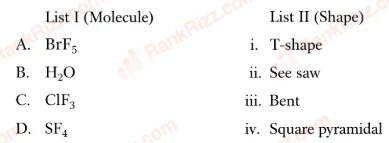
Match List - I with List-II

Figure for JEE Main 2024 Chemistry question on Dinitrogen, ammonia, nitric acid and oxides of nitrogen
  1. A

    (A)-I, (B)-II, (C)-IV, (D)-III

  2. B

    (A)-II, (B)-I, (C)-III, (D)-IV

  3. C

    (A)-III, (B)-IV, (C)-I, (D)-II

  4. D

    (A)-IV, (B)-III, (C)-I, (D)-II

JEE MAIN 2024 · 30 JAN S2Group 16: trends, dioxygen, ozone and oxidesTRANSCRIBED

Given below are two statements: One is labelled as Assertion A and the other is labelled as Reason R.
Assertion A: H2TeH_2Te is more acidic than H2SH_2S.
Reason R: Bond dissociation enthalpy of H2TeH_2Te is lower than H2SH_2S.
In the light of the above statements, choose the most appropriate from the options given below.

  1. A

    Both A and R are true but R is NOT the correct explanation of A.

  2. B

    Both A and R are true and R is the correct explanation of A.

  3. C

    A is false but R is true.

  4. D

    A is true but R is false.