JEE Advanced 2023 Chemistry question — Nucleophilic substitution (SN1 and SN2)
In the following reactions, P, Q, R, and S are the major products.
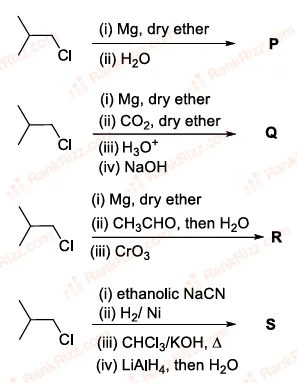
The correct statement about P, Q, R, and S is
SOLUTION
The substrate is isobutyl chloride, , which forms the Grignard reagent with Mg in dry ether.
P: water protonates the Grignard reagent and gives isobutane, , an alkane and not an alcohol, so (A) is wrong.
Q: carboxylation with followed by gives 3-methylbutanoic acid, , and NaOH converts it to the sodium salt Q, . Kolbe electrolysis loses at the anode and couples two isobutyl radicals:
The product, 2,5-dimethylhexane, has eight carbons, so (B) is correct.
R: addition to gives the secondary alcohol 4-methylpentan-2-ol, , which oxidises to 4-methylpentan-2-one, . R has six carbons but is a ketone with -hydrogens, so it does not undergo the Cannizzaro reaction; (C) is wrong.
S: substitution gives , which /Ni reduces to . The carbylamine reaction converts this amine to the isocyanide , and reduces the isocyanide to . S has six carbons but is a secondary amine, so (D) is wrong.
Hence, the correct option is (B).
Tagged Nucleophilic substitution (SN1 and SN2). Machine-assigned, so read it as a strong shortlist rather than a verdict.