JEE ADVANCED 2008 · PAPER 1MEDIUMTRANSCRIBED
JEE Advanced 2008 Chemistry question — Haloarenes
The major product of the following reaction is
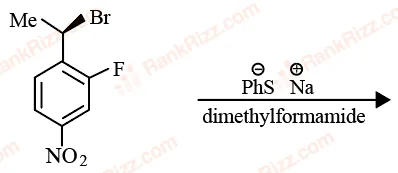
SOLUTION
Key idea: in DMF (a polar aprotic solvent) is an excellent soft nucleophile, so it carries out SN2 at the secondary benzylic C–Br with inversion of configuration.
- Two possible sites for attack:
- Benzylic C–Br (secondary, activated). SN2 is fast there.
- Aromatic C–F (SNAr). This needs an EWG ortho/para to F, but is meta to F here, so the ring is not activated for SNAr at that carbon.
- So only the benzylic bromide is substituted, and F stays on the ring.
- SN2 is backside attack, so the wedged Br is replaced by SPh on a hashed bond (Walden inversion).
- (B) keeps the original configuration (retention). (C) and (D) involve SNAr at the C–F carbon, which is not activated.
Answer: (A)
Tagged Haloarenes. Machine-assigned, so read it as a strong shortlist rather than a verdict.