JEE Advanced 2013 Chemistry question — Nucleophilic substitution (SN1 and SN2)
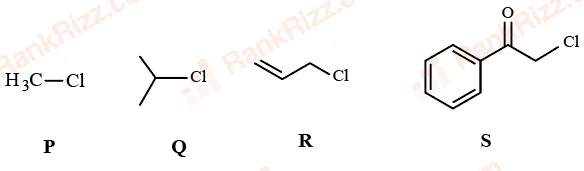
KJ in acetone, undergoes reaction with each of P, Q, R and S. The rates of the reaction vary as
SOLUTION
In KI/acetone, iodide attacks the carbon bearing Cl from the back side, so the rate falls with crowding at that carbon and rises when an adjacent π system stabilises the transition state.
S, (phenacyl chloride), is the fastest: the C=O π system overlaps with the p orbital of the reacting carbon in the transition state and makes that carbon strongly electrophilic.
P, , has no alkyl group on the reacting carbon and is the least hindered.
R, , is primary and allylic overlap helps its transition state, so it also reacts fast, at a rate comparable with P.
Q, , is secondary: two methyl groups crowd the back-side approach, so it is the slowest.
With S fastest and Q slowest, the order is S > P > R > Q, the only option that fits.
Hence, the correct option is (B).
Tagged Nucleophilic substitution (SN1 and SN2). Machine-assigned, so read it as a strong shortlist rather than a verdict.