JEE Advanced 2016 Chemistry question — Structural isomerism
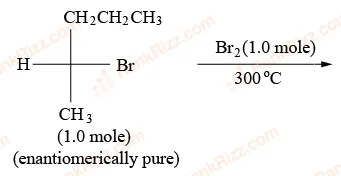
In the following monobromination reaction, the number of possible chiral products is
SOLUTION
The substrate is enantiomerically pure (R)-2-bromopentane, , whose only stereocentre is C2. Monobromination replaces one H at C1, C2, C3, C4 or C5; except for substitution at C2 itself, no bond to C2 is broken, so its configuration is retained.
At C1: 1,2-dibromopentane, . C2 remains a stereocentre of a single configuration, so this gives 1 chiral product.
At C2: 2,2-dibromopentane, . C2 now carries two Br atoms and the molecule has no stereocentre, so it is achiral.
At C3: 2,3-dibromopentane, . The new stereocentre C3 forms in both configurations, giving two diastereomers (erythro and threo). The two ends of the chain ( and ) differ, so no meso form is possible and both are chiral: 2 chiral products.
At C4: 2,4-dibromopentane, . C4 forms in both configurations: (2R,4R)-2,4-dibromopentane is chiral, while (2R,4S)-2,4-dibromopentane has a mirror plane through C3 and is meso: 1 chiral product.
At C5: 1,4-dibromopentane, , with the original stereocentre retained: 1 chiral product.
Number of chiral products .
Hence, the answer is 5.
Tagged Structural isomerism. Machine-assigned, so read it as a strong shortlist rather than a verdict.