JEE Advanced 2020 Chemistry question — Le Chatelier's principle and factors affecting equilibrium
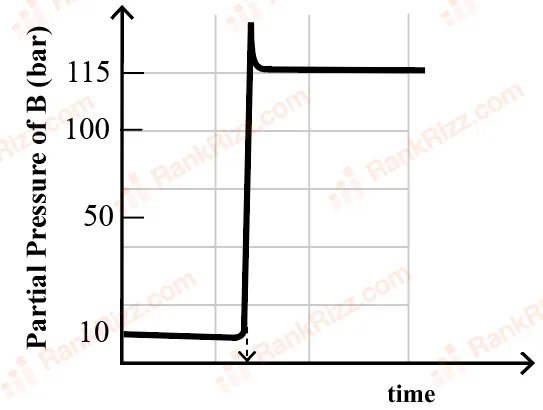
Consider the reaction A B at 1000 K. At time t’, the temperature of the system was increased to 2000 K and the system was allowed to reach equilibrium. Throughout this experiment the partial pressure of A was maintained at 1 bar. Given below is the plot of the partial pressure of B with time.
What is the ratio of the standard Gibbs energy of the reaction at 1000 K to that at 2000 K?
SOLUTION
At every moment the partial pressure of A is kept constant at . For the reaction the equilibrium constant (in terms of pressure) is therefore
because .
From the graph (region before time , i.e. at 1000 K) the equilibrium value of the partial pressure of B is read as
.
Hence, at 1000 K,
Immediately after the temperature is raised to 2000 K and the system is allowed to re-equilibrate, the graph shows the new steady value
.
Therefore, at 2000 K,
The standard Gibbs free energy change is related to the equilibrium constant by
.
Taking the ratio of the standard Gibbs energies at the two temperatures:
Thus, the required ratio of the standard Gibbs energies is 0.25.
Tagged Le Chatelier's principle and factors affecting equilibrium. Machine-assigned, so read it as a strong shortlist rather than a verdict.