JEE Advanced 2020 Chemistry question — Colour and magnetic behaviour of complexes from CFT
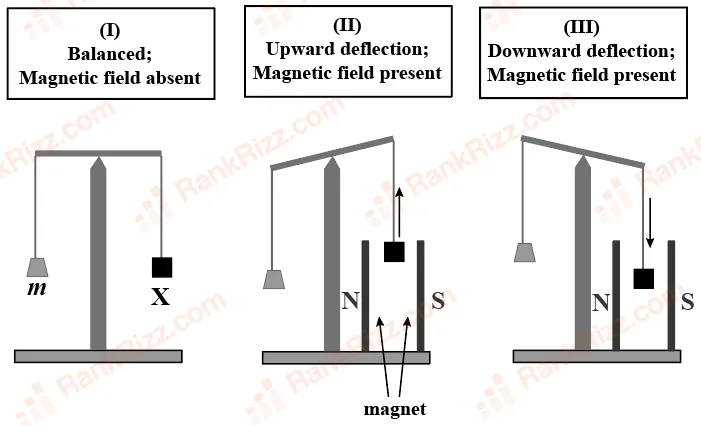
In an experiment, 𝑚 grams of a compound X (gas/liquid/solid) taken in a container is loaded in a balance as shown in figure I below. In the presence of a magnetic field, the pan with X is either deflected upwards (figure II), or deflected downwards (figure III), depending on the compound X. Identify the correct statement(s).
SOLUTION
When a uniform magnetic field is switched on below the sample pan of a sensitive balance, the apparent weight of the sample changes because a magnetic force also acts on it.
• If the substance is paramagnetic (has one or more unpaired electrons), it is attracted into the field. The magnetic force acts downwards, increasing the apparent weight, so the pan is deflected downwards (figure III).
• If the substance is diamagnetic (all electrons paired), it is repelled by the field. The magnetic force acts upwards, decreasing the apparent weight, so the pan is deflected upwards (figure II).
Hence we only need to decide whether each compound is para- or diamagnetic.
Case A:Water contains only paired electrons (its valence shell configuration is for each O, with bonding σ and π pairs). It is therefore diamagnetic pan moves upwards. Statement A is correct.
Case B:Inside the anion the oxidation state of iron is
Fe(II) is a ion. CN− is a strong-field ligand, so the complex is low-spin:
All six electrons are paired; the complex (and therefore the salt) is diamagnetic pan moves upwards. Statement B is correct.
Case C:Molecular orbital theory gives the ground-state configuration
The two electrons in the degenerate orbitals are unpaired, so is paramagnetic pan moves downwards. Statement C is correct.
Case D: (benzene)Benzene has a completely filled set of bonding π-molecular orbitals and no unpaired electrons. It is diamagnetic, so the pan should move upwards, not downwards. Statement D is incorrect.
Therefore the correct statements are:
Option A (water, upwards), Option B (, upwards), Option C (, downwards).
Final answer: Option A, Option B, Option C.
Tagged Colour and magnetic behaviour of complexes from CFT. Machine-assigned, so read it as a strong shortlist rather than a verdict.