RankRizz
JEE ADVANCED 2021 · PAPER 2+4 / −2MEDIUMTRANSCRIBED

JEE Advanced 2021 Chemistry question — Rate law, order and molecularity

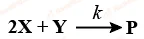
For the following reaction

Figure for JEE Advanced 2021 Chemistry question on Rate law, order and molecularity

the rate of reaction is d[P]dt=k[X]\frac{d[P]}{dt} = k[X]. Two moles of X are mixed with one mole of Y to make 1.0 L of solution. At 50 s, 0.5 mole of Y is left in the reaction mixture. The correct statement(s) about the reaction is(are)
(Use: ln 2 = 0.693)

SOLUTION

The rate law is given as d[P]dt=k[X]\frac{d[P]}{dt}=k[X]. This is a first-order rate law with respect to XX and it is written for the formation of one mole of PP.

Step 1 : Deduce the stoichiometric coefficients.
Initially: [X]0=2  M,  [Y]0=1  M[X]_0 = 2\;{\rm M},\;[Y]_0 = 1\;{\rm M} in a 1 L solution.
After 50 s: [Y]=0.5  M[Y] = 0.5\;{\rm M}, so 0.5  mol  L−10.5\;{\rm mol\;L^{-1}} of YY has reacted.

Let the balanced equation be νX+Y→P\nu X + Y \rightarrow P. For every mole of YY consumed, ν\nu moles of XX are consumed and one mole of PP is formed.

Since 0.5 M of YY is consumed in 50 s, consumption of XX is ν×0.5  M\nu \times 0.5 \;{\rm M}.
Thus [X]50 s=2−0.5ν  M[X]_{50\,{\rm s}} = 2 - 0.5\nu \;{\rm M} −(1)-(1)

Step 2 : Use the integrated first-order equation.
For a first-order process, ln⁡ ⁣([X]0[X])=kt\ln\!\left(\frac{[X]_0}{[X]}\right)=kt −(2)-(2)

Substituting [X]0=2  M,  [X]=2−0.5ν  M,  t=50  s[X]_0 = 2\;{\rm M},\;[X]=2-0.5\nu \;{\rm M},\;t = 50\;{\rm s} in (2)(2) gives ln⁡ ⁣(2 2−0.5ν )=k(50)\ln\!\left(\frac{2}{\,2-0.5\nu\,}\right)=k(50) −(3)-(3)

The problem data are such that ln⁡2=0.693\ln 2 = 0.693 appears useful. If [X]50 s=1  M[X]_{50\,{\rm s}} = 1\;{\rm M} (i.e. the concentration of XX exactly halves), then 2−0.5ν=1  ⟹  ν=22-0.5\nu = 1 \;\Longrightarrow\; \nu = 2. Hence the balanced reaction is

2X+Y→P2X + Y \rightarrow P

Step 3 : Evaluate the rate constant, kk.
Putting [X]=1  M[X]=1\;{\rm M} in (2)(2), ln⁡ ⁣(21)=k(50)  ⟹  0.693=50k  ⟹  k=0.69350=0.01386  s−1\ln\!\left(\frac{2}{1}\right)=k(50) \;\Longrightarrow\; 0.693 = 50k \;\Longrightarrow\; k = \frac{0.693}{50} = 0.01386\;{\rm s^{-1}} −(4)-(4)

Step 4 : Half-life of XX.
For a first-order reaction, t1/2=ln⁡2kt_{1/2}=\frac{\ln 2}{k}.
Using (4)(4), t1/2=0.6930.01386=50  st_{1/2} = \frac{0.693}{0.01386} = 50\;{\rm s} −(5)-(5)

Step 5 : Check each statement.

Option A: proposes k=13.86×10⁻⁴  s−1=1.386×10⁻³  s−1k = 13.86 \times 10^{-4}\;{\rm s^{-1}} = 1.386 \times 10^{-3}\;{\rm s^{-1}}. Actual kk from (4)(4) is 1.386×10⁻²  s−11.386 \times 10^{-2}\;{\rm s^{-1}}, an order of magnitude larger. Option A is incorrect.

Option B: states the half-life of XX is 50 s. Equation (5)(5) confirms this. Option B is correct.

Option C: asks for −d[X]dt-\frac{d[X]}{dt} at 50 s.
Because the stoichiometric coefficient of XX is 2, −d[X]dt=2d[P]dt=2k[X]-\frac{d[X]}{dt}=2\frac{d[P]}{dt}=2k[X] −(6)-(6) At 50 s, [X]=1  M[X]=1\;{\rm M} and k=0.01386  s−1k=0.01386\;{\rm s^{-1}}, so −d[X]dt=2(0.01386)(1)=0.02772  mol L−1 s−1=27.72×10⁻³  mol L−1 s−1-\frac{d[X]}{dt}=2(0.01386)(1)=0.02772\;{\rm mol\,L^{-1}\,s^{-1}} = 27.72 \times 10^{-3}\;{\rm mol\,L^{-1}\,s^{-1}}, not 13.86×10−313.86 \times 10^{-3} as stated. Option C is incorrect.

Option D: To find −d[Y]dt-\frac{d[Y]}{dt} at 100 s, first get [X]100[X]_{100}. From (2)(2), [X]100=2e−k(100)=2e−1.386=0.5  M[X]_{100}=2e^{-k(100)} = 2e^{-1.386}=0.5\;{\rm M}. Rate of formation of PP is k[X]=0.01386(0.5)=0.00693  mol L−1 s−1k[X]=0.01386(0.5)=0.00693\;{\rm mol\,L^{-1}\,s^{-1}}. Since one mole of YY is consumed per mole of PP formed, −d[Y]dt=0.00693  mol L−1 s−1=6.93×10⁻³  mol L−1 s−1-\frac{d[Y]}{dt}=0.00693\;{\rm mol\,L^{-1}\,s^{-1}} = 6.93 \times 10^{-3}\;{\rm mol\,L^{-1}\,s^{-1}}, not 3.46×10−33.46 \times 10^{-3}. Option D is incorrect.

Hence, the only correct choice is:
Option B which is: Half-life of X is 50 s.
Tagged Rate law, order and molecularity. Machine-assigned, so read it as a strong shortlist rather than a verdict.

SubjectChemistry
TopicRate law, order and molecularity
TypeMultiple correct