RankRizz

Chemical Bonding and Molecular Structure — JEE Advanced Previous Year Questions

Every Chemical Bonding and Molecular Structure question JEE Advanced has set from 2007–2026, grouped by the idea it tests rather than the order of the syllabus. 33 questions across 7 distinct ideas. Free to read, answer key on every one.

Questions

33

Distinct ideas

7

Share of marks

5.1%

Difficulty

EASY

The ideas inside Chemical Bonding and Molecular Structure

A chapter is not one subject — it is a handful of procedures the examiner reuses. These are the ones Chemical Bonding and Molecular Structure questions actually test.

01Ionic bonding, lattice energy and Born-Haber cycleNot set in Advanced
02Fajans' rules, polarisation and covalent characterset 1×
03Lewis structures, formal charge and coordinate bondsNot set in Advanced
04Resonance and bond parametersset 1×
05VSEPR theory and shapes of molecules and ionsset 13×
06Hybridisation and bond anglesNot set in Advanced
07Valence bond theory, orbital overlap and sigma/pi bondsset 1×
08Dipole moment and molecular polarityset 3×
09Molecular orbital theory of diatomic speciesset 10×
10Hydrogen bonding and intermolecular forcesset 4×
11Back bonding and electron-deficient bondingNot set in Advanced

Every Chemical Bonding and Molecular Structure question

21–33 OF 33 · NEWEST FIRST

JEE ADVANCED 2014 · PAPER 1Hydrogen bonding and intermolecular forcesTRANSCRIBED

Hydrogen bonding plays a central role in the following phenomena:

  1. A

    Ice floats in water.

  2. B

    Higher Lewis basicity of primary amines than tertiary amines in aqueous solutions.

  3. C

    Formic acid is more acidic than acetic acid.

  4. D

    Dimerisation of acetic acid in benzene.
JEE ADVANCED 2014 · PAPER 2Molecular orbital theory of diatomic speciesTRANSCRIBED

Assuming 2s-2p mixing is NOT operative, the paramagnetic species among the following is

  1. A

    Be2Be_2

  2. B

    B2B_2

  3. C

    C2C_2

  4. D

    N2N_2

JEE ADVANCED 2014 · PAPER 1VSEPR theory and shapes of molecules and ionsTRANSCRIBED

A list of species having the formula XZ4XZ_4 is given below.
XeF4,SF4,SiF4,BF4−,BrF4−,[Cu(NH3)4]2+,[FeCl4]2−,[CoCl4]2−XeF_4 , SF_4 , SiF_4 , BF_4^- , BrF_4^- , [Cu(NH_3)_4]^{2+}, [FeCl_4]^{2-}, [CoCl_4]^{2-} and [PtCl4]2−[PtCl_4]^{2-}.
Defining shape on the basis of the location of X and Z atoms, the total number of species having a square planar shape is

JEE ADVANCED 2014 · PAPER 2Valence bond theory, orbital overlap and sigma/pi bondsTRANSCRIBED

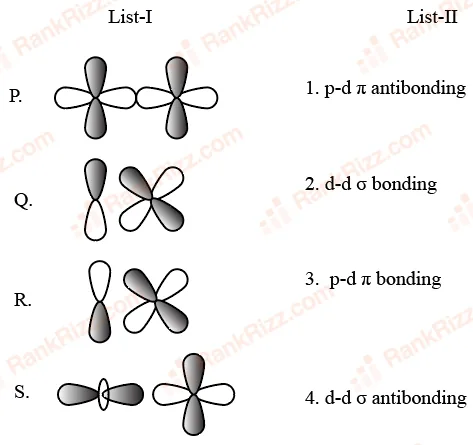
Match the orbital overlap figures shown in List-I with the description given in List-II and select the correct answer using the code given below the lists.

Figure for JEE Advanced 2014 Chemistry question on Valence bond theory, orbital overlap and sigma/pi bonds
  1. A

    P - 2, Q - 1, R - 3, S - 4

  2. B

    P - 4, Q - 3, R - 1, S - 2

  3. C

    P - 2, Q - 3, R - 1, S - 4

  4. D

    P - 4, Q - 1, R - 3, S - 2

JEE ADVANCED 2012 · PAPER 2VSEPR theory and shapes of molecules and ionsTRANSCRIBED

The shape of XeO2F2XeO_2F_2 molecule is

  1. A

    trigonal bipyramidal

  2. B

    square plannar

  3. C

    tetrahedral

  4. D

    see-saw

JEE ADVANCED 2011 · PAPER 1VSEPR theory and shapes of molecules and ionsTRANSCRIBED

Geometrical shapes of the complexes formed by the reaction of Ni2+Ni^{2+} with Cl−,CN−Cl^-, CN^- ans H2OH_2O, respectively, are

  1. A

    octahedral, tetrahedral and square planar

  2. B

    tetrahedral, square planar and octahedral

  3. C

    square planar, tetrahedral and octahedral

  4. D

    octahedral, square planar and octahedral

JEE ADVANCED 2010 · PAPER 2VSEPR theory and shapes of molecules and ionsTRANSCRIBED

The species having pyramidal shape is

  1. A

    SO3SO_3

  2. B

    BrF3BrF_3

  3. C

    SiO32−SiO_{3}^{2-}

  4. D

    OSF2OSF_2

JEE ADVANCED 2010 · PAPER 2Molecular orbital theory of diatomic speciesTRANSCRIBED

Assuming that Hund's rule is violated, the bond order and magnetic nature of the diatomic molecule B2B_2 is

  1. A

    1 and diamagnetic

  2. B

    1 and paramagnetic

  3. C

    O and diamagnetic

  4. D

    O and paramagnetic

JEE ADVANCED 2010 · PAPER 1VSEPR theory and shapes of molecules and ionsTRANSCRIBED

Based on VSEPR theory, the number of 90 degree F-Br-F angles in BrF5BrF_{5} is

JEE ADVANCED 2009 · PAPER 1Molecular orbital theory of diatomic speciesTRANSCRIBED

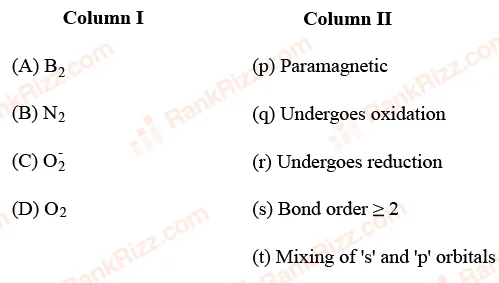
Match each of the diatomic molecules in Column I with its property/properties in Column II

Figure for JEE Advanced 2009 Chemistry question on Molecular orbital theory of diatomic species
JEE ADVANCED 2007 · PAPER 1Molecular orbital theory of diatomic speciesTRANSCRIBED

The species having bond order different from that in CO is

  1. A

    NO−NO^{-}

  2. B

    NO+NO^{+}

  3. C

    CN−CN^{-}

  4. D

    N2N_2

JEE ADVANCED 2007 · PAPER 1Molecular orbital theory of diatomic speciesTRANSCRIBED

Among the following, the paramagnetic compound is

  1. A

    Na2O2Na_2O_2

  2. B

    N2ON_2O

  3. C

    O3O_3

  4. D

    KO2KO_2

JEE ADVANCED 2007 · PAPER 1Resonance and bond parametersTRANSCRIBED

STATEMENT-1 : Boron always forms covalent bond.
because
STATEMENT-2: The small size of B3+B^{3+} favours formation of covalent bond.

  1. A

    Statement-1 is True, Statement-2 is True; Statement-2 is a correct explanation for Statement-1

  2. B

    Statement-1 is True, Statement-2 is True; Statement-2 is NOT a correct explanation for Statement-1

  3. C

    Statement-1 is True, Statement-2 is False

  4. D

    Statement-1 is False, Statement-2 is True