JEE Advanced 2014 Chemistry question — Valence bond theory, orbital overlap and sigma/pi bonds
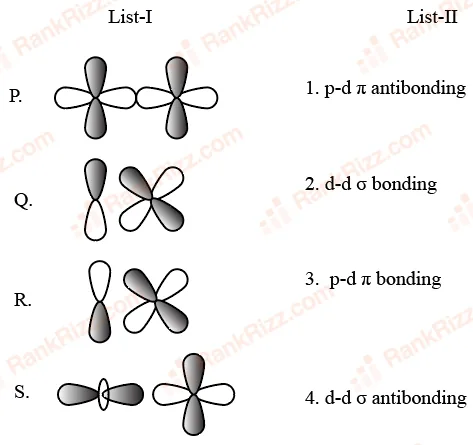
Match the orbital overlap figures shown in List-I with the description given in List-II and select the correct answer using the code given below the lists.
SOLUTION
The shading shows the phase of each lobe: lobes of the same shading that overlap give a bonding combination, lobes of opposite shading give an antibonding one. Lobes meeting head-on along the internuclear axis form a overlap; lobes meeting side-on, above and below the axis, form a overlap.
P: two orbitals meet head-on through their unshaded axial lobes, which have the same phase, so P is bonding (2).
Q: the shaded upper lobe of the orbital faces a shaded lobe of the orbital and its unshaded lower lobe faces an unshaded lobe, side-on, so Q is bonding (3).
R: the same side-on – approach, but each lobe faces a lobe of opposite shading, so R is antibonding (1).
S: the left orbital is (two axial lobes with the small ring around the nucleus); its shaded lobe meets the unshaded axial lobe of the other orbital head-on, so S is antibonding (4).
The matching P-2, Q-3, R-1, S-4 is option (C).
Hence, the correct option is (C).
Tagged Valence bond theory, orbital overlap and sigma/pi bonds. Machine-assigned, so read it as a strong shortlist rather than a verdict.