JEE Main 2021 Physics question — Speed of efflux and applications of Bernoulli's theorem
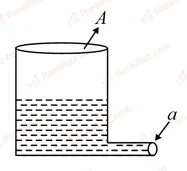
A light cylindrical vessel is kept on a horizontal surface. Area of the base is . A hole of cross-sectional area is made just at its bottom side. The minimum coefficient of friction necessary to prevent sliding the vessel due to the impact force of the emerging liquid is
SOLUTION
We need to determine the minimum coefficient of friction () required to keep a light cylindrical vessel stationary when liquid flows out of a small hole at its bottom.
1. Identify the Forces Acting on the Vessel
From the problem , two main horizontal forces govern whether the cylinder will slide:
-
Thrust Force ():
As liquid escapes through the small hole of cross-sectional area , it exerts an equal and opposite reaction force (thrust) on the vessel. According to hydrodynamic principles, this force is given by:Where is the density of the liquid, and is the velocity of efflux. By Torricelli's Law, (where is the height of the liquid column). Substituting this gives:
-
Limiting Friction Force ():
The maximum static friction resisting the sliding movement depends on the normal reaction force () from the surface:Since the cylindrical vessel itself is described as "light" (mass of the container is negligible), the normal force is solely due to the weight of the liquid inside it:
Where is the base cross-sectional area of the vessel. Therefore, the maximum friction is:
2. Apply the Equilibrium Condition
To prevent the vessel from sliding, the limiting friction force must be greater than or equal to the horizontal impact thrust force:
Substitute our derived expressions for both forces into the inequality:
We can simplify the expression by canceling out the common terms ( and ) from both sides:
Isolating the friction coefficient ():
Conclusion
The minimum coefficient of friction necessary to prevent the cylinder from moving is:
This corresponds exactly to Option C.
Tagged Speed of efflux and applications of Bernoulli's theorem. Machine-assigned, so read it as a strong shortlist rather than a verdict.