JEE Advanced 2020 Physics question — Rolling with friction, slipping and impulsive forces
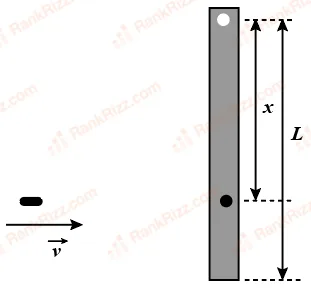
A rod of mass 𝑚 and length 𝐿, pivoted at one of its ends, is hanging vertically. A bullet of the same mass moving at speed 𝑣 strikes the rod horizontally at a distance 𝑥 from its pivoted end and gets embedded in it. The combined system now rotates with angular speed about the pivot. The maximum angular speed is achieved for . Then
SOLUTION
The bullet-rod collision is very quick, so the external impulse torque about the pivot is negligible. Hence the angular momentum about the pivot is conserved during the impact.
Step 1 Initial angular momentum of the bullet
The bullet of mass travels horizontally with speed and hits the rod at a perpendicular distance from the pivot.
Magnitude of angular momentum about the pivot:
Step 2 Moment of inertia of the combined system after the impact
• Uniform rod of mass , length , about one end: .
• Bullet embedded at distance from the pivot: .
Total moment of inertia:
Step 3 Angular speed immediately after the collision
Conserving angular momentum, :
Cancelling and rearranging,
This matches Option A.
Step 4 Finding the value of that maximises
Write .
Differentiate with respect to and set to zero:
Hence
This gives Option C.
Step 5 Maximum angular speed
Substitute into the expression for :
Numerator: .
Denominator: .
Therefore
This corresponds to Option D.
Step 6 Checking the remaining option
Option B gives , which does not agree with the derived expression, so it is incorrect.
Final result
Correct options: Option A, Option C, Option D.
Tagged Rolling with friction, slipping and impulsive forces. Machine-assigned, so read it as a strong shortlist rather than a verdict.