JEE Advanced 2013 Physics question — Prism: deviation and dispersion
A right angled prism of refractive index is placed in a rectangular block of refractive index , which is surrounded by a medium of refractive index , as Shown in the figure. A ray of light ‘e’ enters the rectangular block at normal incidence. Depending upon the relationships between and , it takes one of the four possible paths ‘ef’, ‘eg’, ‘eh’ or ‘ei’.
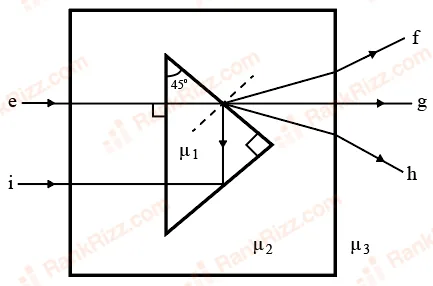
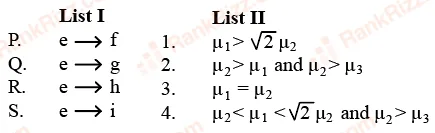
Match the paths in List I with conditions of refractive indices in List II and select the correct answer using the codes given below the lists:
SOLUTION
Key idea: The ray meets the hypotenuse of the prism at . What happens there (no bending, bending towards or away from the normal, or TIR) depends on versus . The bending at the block's exit face depends on versus .
- e → g (undeviated): no refraction at the prism face, so . Q–3.
- e → i (TIR): total reflection needs , i.e. . S–1.
- e → f: at the hypotenuse the ray bends towards the normal (upward), so it enters a denser medium: . At the exit face it bends further from the normal, so . P–2.
- e → h: at the hypotenuse it bends away from the normal without TIR, so . It then bends away again on leaving the block, so . R–4.
- P–2, Q–3, R–4, S–1 is option (D).
Answer: (D)
Tagged Prism: deviation and dispersion. Machine-assigned, so read it as a strong shortlist rather than a verdict.