JEE ADVANCED 2010 · PAPER 1MEDIUMTRANSCRIBED
JEE Advanced 2010 Physics question — Prism: deviation and dispersion
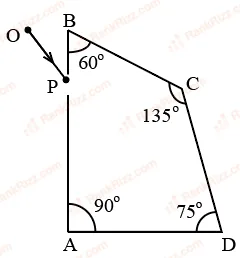
A ray OP of monochromatic light is incident on the face AB of prism ABCD near vertex B at an incident angle of (see figure). If the refractive index of the material of the prism is , which of the following is (are) correct ?
SOLUTION
Key idea: Trace the ray with Snell's law and the critical-angle test, using the prism angles .
- At AB (a vertical face): . The refracted ray travels below the horizontal.
- Face BC also makes below the horizontal (because with the vertical AB). The ray enters near B and runs parallel to BC, so it reaches face CD.
- At CD: CD makes with the horizontal (from ), so its outward normal is above the horizontal. Angle of incidence . Critical angle: . Since , the ray is totally internally reflected, so (A) is correct.
- The reflected ray travels below the horizontal (towards the lower left). It strikes the base AD at to the normal: So it emerges through AD, and (B) is correct.
- Directions: the incident ray points below the horizontal towards the right. The emergent ray points from the downward vertical towards the left, i.e. below the horizontal towards the left. The angle between them is . So (C) is correct and (D) is wrong.
Answer: (A), (B), (C)
Tagged Prism: deviation and dispersion. Machine-assigned, so read it as a strong shortlist rather than a verdict.