JEE Advanced 2020 Chemistry question — Concentration terms and their interconversion
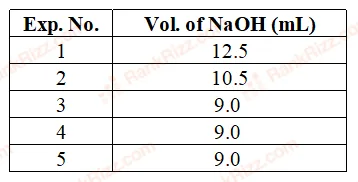
5.00 mL of 0.10 M oxalic acid solution taken in a conical flask is titrated against NaOH from a burette using phenolphthalein indicator. The volume of NaOH required for the appearance of permanent faint pink color is tabulated below for five experiments. What is the concentration, in molarity, of the NaOH solution?
SOLUTION
The burette readings for the five trials (given in the table) are first averaged.
Let the five volumes of noted be (in mL): .
Their mean volume is
Substituting the numerical values supplied in the question, the average comes to
Convert this to litres for use in the molarity equation:
Now calculate the number of moles of oxalic acid present in the conical flask.
Given: volume of oxalic acid solution , and its molarity .
Moles of oxalic acid:
Oxalic acid is diprotic. One mole of reacts with two moles of :
Therefore, moles of required are
Let be the molarity of the solution. Using ,
Hence, the concentration of the solution is
0.11 M.
Tagged Concentration terms and their interconversion. Machine-assigned, so read it as a strong shortlist rather than a verdict.