JEE Advanced 2017 Chemistry question — Relative lowering of vapour pressure
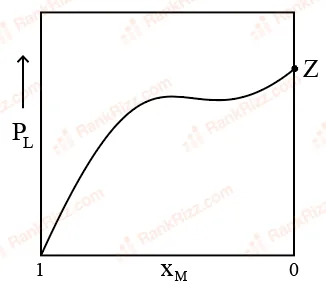
For a solution formed by mixing liquids L and M, the vapour pressure of L plotted against the mole fraction of M in solution is shown in the following figure. Here and represent mole fractions of L and M, respectively, in the solution. The correct statement(s) applicable to this system is(are)
SOLUTION
On the plot, runs from 1 at the left to 0 at the right, so the right end (, ) is pure L and the value of there is . Point Z is the vapour pressure of pure liquid L, so (A) and (C) are wrong.
Raoult's law for L, , is the straight line from at up to Z. The curve meets this line only as it reaches Z, so L obeys Raoult's law only as , where L is the solvent: (B) is correct. The curve is not straight, so Raoult's law is not obeyed from to , which also rules out (A).
Elsewhere the curve lies above the straight line, a positive deviation: L escapes more readily from the mixture than ideality predicts, so L–M attractions are weaker than L–L and M–M attractions: (D) is correct.
Hence, the correct options are (B) and (D).
Tagged Relative lowering of vapour pressure. Machine-assigned, so read it as a strong shortlist rather than a verdict.