JEE Advanced 2020 Chemistry question — Voids, radius ratio and structures of ionic solids
The cubic unit cell structure of a compound containing cation M and anion X is shown below. When compared to the anion, the cation has smaller ionic radius. Choose the correct statement(s).
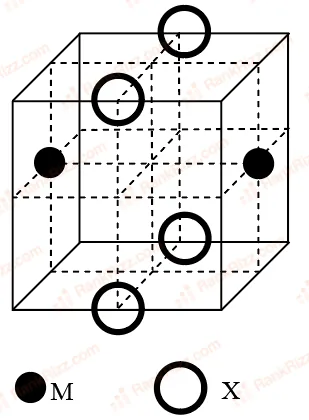
SOLUTION
The anion X occupies all the eight corners of the cube while the smaller cation M is present at the body-centre.
1. Ions per unit cell
• Corner ion contribution = X
• Body-centre ion contribution = 1 M
Therefore a unit cell contains 1 M and 1 X, giving the empirical formula . Hence Option A is correct.
2. Coordination geometry
A corner X is joined to the body-centre M and to the equivalent body-centres of the adjoining cells. Each ion thus has eight nearest neighbours of the opposite kind arranged at the vertices of a cube, i.e. both ions possess 8-coordination (cubic geometry). Because the geometries are identical, Option B is incorrect.
3. M-X bond length versus edge length
The nearest M-X distance is from the body-centre to any corner. This is one-half of the body diagonal:
Thus the stated ratio 0.866 is right, so Option C is correct.
4. Radius ratio
If the two ions just touch along the body diagonal,
and the limiting (minimum) radius ratio for 8-coordination is .
The value 0.414 corresponds to 6-coordination (octahedral holes), not to this structure. Therefore Option D is incorrect.
Hence the correct statements are Option A and Option C.
Final answer: Option A (The empirical formula is MX), Option C (The bond-length to edge-length ratio is 0.866).
Tagged Voids, radius ratio and structures of ionic solids. Machine-assigned, so read it as a strong shortlist rather than a verdict.