RankRizz
JEE MAIN 2014 · 19 APR ONLINE+4 / −1MEDIUMTRANSCRIBED

JEE Main 2014 Physics question — Speed of efflux and applications of Bernoulli's theorem

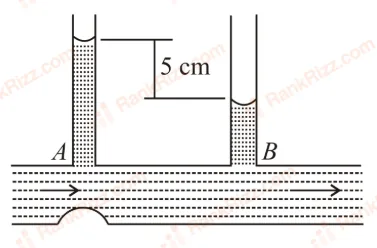
In the diagram shown, the difference in the two tubes of the manometer is 5 cm, the cross-section of the tube at A and B is 6 mm2^2 and 10 mm2^2 respectively. The rate at which water flows through the tube is (g = 10 m s−2^{-2})

Figure for JEE Main 2014 Physics question on Speed of efflux and applications of Bernoulli's theorem
SOLUTION

The pressure difference between the two points is determined by the height difference Δh=5 cm\Delta h = 5\text{ cm} in the manometer:

ΔP=ρgΔh=1 g/cc×103 cm/s2×5 cm=5×10³ dyne/cm2\Delta P = \rho g \Delta h = 1\text{ g/cc} \times 10^3\text{ cm/s}^2 \times 5\text{ cm} = 5 \times 10^3\text{ dyne/cm}^2

Using the equation of continuity A1v1=A2v2A_1v_1 = A_2v_2: 6vA=10vB  ⟹  vA=53vB6v_A = 10v_B \implies v_A = \frac{5}{3}v_B

Substituting this into Bernoulli's equation, 12ρ(vA2−vB2)=PB−PA\frac{1}{2}\rho(v_A^2 - v_B^2) = P_B - P_A:

12×1[(53vB)2−vB2]=5×10³\frac{1}{2} \times 1 \left[ \left(\frac{5}{3}v_B\right)^2 - v_B^2 \right] = 5 \times 10^3

12(169vB2)=5×10³  ⟹  vB=34×102 cm/s\frac{1}{2} \left( \frac{16}{9}v_B^2 \right) = 5 \times 10^3 \implies v_B = \frac{3}{4} \times 10^2\text{ cm/s}

Volume flow rate=vBAB=(34×102)×(10×10−2)=7.5 cc/s\text{Volume flow rate} = v_B A_B = \left(\frac{3}{4} \times 10^2\right) \times (10 \times 10^{-2}) = 7.5\text{ cc/s}

Tagged Speed of efflux and applications of Bernoulli's theorem. Machine-assigned, so read it as a strong shortlist rather than a verdict.

SubjectPhysics
TopicSpeed of efflux and applications of Bernoulli's theorem
TypeMultiple choice