JEE Advanced 2023 Physics question — Doppler effect in sound
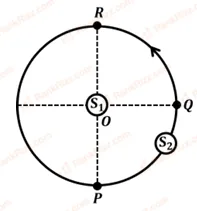
Consider both sources emitting sound. When is at R and approaches the detector with a speed 4 ms, the beat frequency measured by the detector is ____ Hz.
SOLUTION
For a beat to be heard, the detector must receive two slightly different frequencies coming from the two sources. Hence we first calculate the frequency heard from each source.
Step 1 : Frequency heard from
• The observer (detector) is at rest at point P.
• Source moves towards the detector along the line OP with speed .
• For a moving source and a stationary observer, the Doppler-shifted frequency is
where is the speed of sound and is the emitted frequency.
Substituting in :
Step 2 : Frequency heard from
• When is at point R, P and R are diametrically opposite.
• The velocity of is tangential to the circular path. Thus, at R its velocity is perpendicular to the line RP that joins the source to the detector.
• Only the component of velocity along the line of sight contributes to the Doppler effect; here that component is zero.
• Therefore, no Doppler shift occurs and the detector hears the emitted frequency itself:
Step 3 : Beat frequency at the detector
The beat frequency equals the absolute difference of the two received frequencies:
Hence, the beat frequency measured by the detector is 8.2 Hz.
Tagged Doppler effect in sound. Machine-assigned, so read it as a strong shortlist rather than a verdict.