JEE Advanced 2024 Physics question — Doppler effect in sound
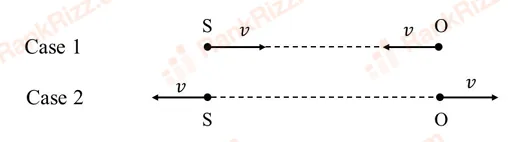
A source () of sound has frequency 240 Hz. When the observer () and the source move towards each other at a speed with respect to the ground (as shown in Case 1 in the figure), the observer measures the frequency of the sound to be 288 Hz. However, when the observer and the source move away from each other at the same speed with respect to the ground (as shown in Case 2 in the figure), the observer measures the frequency of sound to be Hz. The value of is ______.
SOLUTION
The Doppler-shift formula for sound (air at rest) is
where
= speed of sound in air, = speed of the observer, = speed of the source.
Use the plus sign in the numerator when the observer moves \textit{towards} the source and the minus sign when he moves \textit{away}.
Use the minus sign in the denominator when the source moves \textit{towards} the observer and the plus sign when it moves \textit{away}.
The magnitude of the velocity of both source and observer relative to the ground is given as in each case.
Case 1: Moving towards each otherObserver approaches the source numerator .
Source approaches the observer denominator .
Hence
Simplify:
Observer recedes from the source numerator .
Source recedes from the observer denominator .
Therefore
Insert from :
Thus
Therefore, the observed frequency in Case 2 is 200 Hz.
Tagged Doppler effect in sound. Machine-assigned, so read it as a strong shortlist rather than a verdict.