RankRizz

Waves — JEE Advanced Previous Year Questions

Every Waves question JEE Advanced has set from 2007–2026, grouped by the idea it tests rather than the order of the syllabus. 36 questions across 4 distinct ideas. Free to read, answer key on every one.

Questions

36

Distinct ideas

4

Share of marks

4.3%

Difficulty

MEDIUM

The ideas inside Waves

A chapter is not one subject — it is a handful of procedures the examiner reuses. These are the ones Waves questions actually test.

01Progressive waves: wave equation, phase and intensityset 7×
02Speed of waves on strings and of sound in mediaNot set in Advanced
03Superposition, interference and beatsset 12×
04Standing waves on strings and rodsset 1×
05Organ pipes and resonance columnsNot set in Advanced
06Doppler effect in soundset 16×

Every Waves question

21–36 OF 36 · NEWEST FIRST

JEE ADVANCED 2013 · PAPER 1Progressive waves: wave equation, phase and intensityTRANSCRIBED

A horizontal stretched string, fixed at two ends, is vibrating in its fifth harmonic according to the equation, y(x,t)=(0.01m)sin⁡[(62.8m−1)x]cos⁡[(628s−1)t].y(x, t) = (0.01 m) \sin [(62.8 m^{-1}) x] \cos [(628 s^{-1})t]. Assuming π=3.14\pi = 3.14, the correct statement(s) is (are)

  1. A

    The number of nodes is 5.

  2. B

    The length of the string is 0.25 m.

  3. C

    The maximum displacement of the midpoint of the string, from its equilibrium position is 0.01 m.

  4. D

    The fundamental frequency is 100 Hz.
JEE ADVANCED 2012 · PAPER 2Superposition, interference and beatsTRANSCRIBED

A student is performing the experiment of Resonance Column. The diameter of the column tube is 4cm . The distance frequency of the tuning for k is 512 Hz. The air temperature is 38∘C38^\circ C in which the speed of sound is 336 m/s. The zero of the meter scale coincides with the top and of the Resonance column. When first resonance occurs, the reading of the water level in the column is

  1. A

    14.0

  2. B

    15.2

  3. C

    16.4

  4. D

    17.6

JEE ADVANCED 2012 · PAPER 1Superposition, interference and beatsTRANSCRIBED

A person blowsinto open-end of a long pipe. As a result, a high-pressure pulseof air travels down the pipe. Whenthis pulse reachesthe other endof the pipe,

  1. A

    a high-pressure pulsestarts traveling up the pipe, if the other end of the pipe is open.

  2. B

    a low-pressure pulsestarts traveling up the pipe, if the other end ofthe pipe is open.

  3. C

    alow-pressure pulsestarts traveling up the pipe, if the other end of the pipe is closed.

  4. D

    a high-pressure pulse starts traveling up the pipe, if the other end of the pipe is closed.

JEE ADVANCED 2011 · PAPER 1Doppler effect in soundTRANSCRIBED

A police car with a siren of frequency 8 kHz is moving with uniform velocity 36 km/hr towards a tall building which reflects the sound waves. The speed of sound in air is 320 m/s. The frequency of the siren heard by the car driver is-

  1. A

    8.50 kHz

  2. B

    8.25 kHz

  3. C

    7.75 kHz

  4. D

    7.50 kHz

JEE ADVANCED 2011 · PAPER 2Superposition, interference and beatsTRANSCRIBED

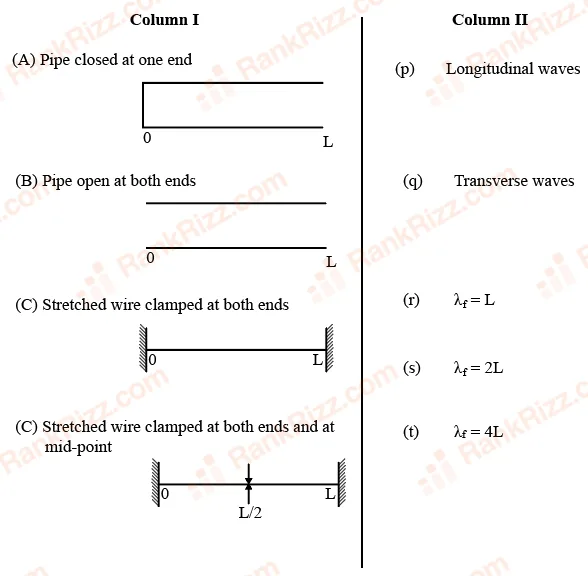
Column I shows four systems, each of the same length L, for producing standing waves. The lowest possible natural frequency of a system is called its fundamental frequency, whose wavelength is denoted as λf\lambda_f. Match each system with statements given in Column II describing the nature and wavelength of the standing waves.

Figure for JEE Advanced 2011 Physics question on Superposition, interference and beats
JEE ADVANCED 2010 · PAPER 2Superposition, interference and beatsTRANSCRIBED

A hollowpipe of length 0.8 mis closed at one end. At its open end a 0.5 mlong uniform string is vibrating in its second harmonic and it resonates with the fundamental frequencyof the pipe. If the tension in the wire is 50 N and the speed of sound is 320 ms−1^{-1}, the massof thestring is

  1. A

    5 grams

  2. B

    10 grams

  3. C

    20 grams

  4. D

    40 grams

JEE ADVANCED 2010 · PAPER 1Superposition, interference and beatsTRANSCRIBED

When two progressive waves y1=4sin⁡(2x−6t)y_1 = 4 \sin(2x - 6t) and y2=3sin⁡(2x−6t−π2)y_2 = 3 \sin\left(2x - 6t - \frac{\pi}{2}\right) are superimposed, the amplitude of the resultant wave is

JEE ADVANCED 2010 · PAPER 1Doppler effect in soundTRANSCRIBED

A stationary source is emitting sound ata fixed frequency f0f_0, which is reflected by two cars approaching the source. The difference between the frequencies of sound reflected from the cars is 1.2% of f0f_0. What is the difference in the speeds of the cars (in km per hour) to the nearest integer ? The cars are moving at constant speeds much smaller than the speed of sound which is 330 ms−1ms^{-1}.

JEE ADVANCED 2009 · PAPER 2Superposition, interference and beatsTRANSCRIBED

A student performed the experiment to measure the speed of sound in air using resonance air-column method. Two resonances in the air-column were obtained by lowering the water level. The resonance with the shorter air-column is the first resonanceandthat with the longer air-column is the second resonance. Then,

  1. A

    the intensity of the sound heard at the first resonance was more than that at the second resonance

  2. B

    the prongs of the tuning fork were kept in a horizontal plane above the resonance tube

  3. C

    the amplitude of vibration of the ends of the prongsis typically around 1 cm

  4. D

    the length of the air-columnat the first resonance was somewhat shorter than 14th\frac{1}{4}th of the wavelength of the sound in air

JEE ADVANCED 2009 · PAPER 2Progressive waves: wave equation, phase and intensityTRANSCRIBED

A 20 cm long string, having a mass of 1.0 g, is fixed at both the ends. The tension in tne string is 0.5 N. The string is set into vibrations using an external vibrator of
frequency 100 Hz. Find the separation (in em) between the successive nodes on the string.

JEE ADVANCED 2008 · PAPER 2Progressive waves: wave equation, phase and intensityTRANSCRIBED

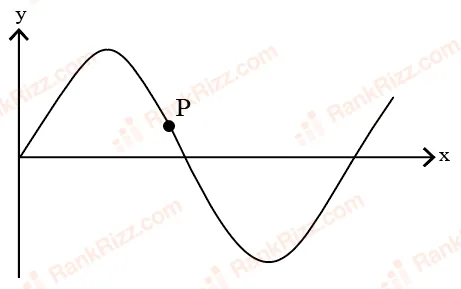
A transverse sinusoidal wave moves along a string in the positive x-direction at a speed of 10 cm/s. The wavelength of the waveis 0.5 m and its amplitude is 10 cm. At a particular time t, the snap-shot of the wave is shown in figure. The velocity of point P when its displacement is 5 cm is

Figure for JEE Advanced 2008 Physics question on Progressive waves: wave equation, phase and intensity
  1. A

    3π50j^\frac{\sqrt{3}\pi}{50}\hat{j} m/s

  2. B

    −3π50j^-\frac{\sqrt{3}\pi}{50}\hat{j} m/s

  3. C

    3π50i^\frac{\sqrt{3}\pi}{50}\hat{i} m/s

  4. D

    −3π50i^-\frac{\sqrt{3}\pi}{50}\hat{i} m/s

JEE ADVANCED 2008 · PAPER 2Superposition, interference and beatsTRANSCRIBED

A vibrating string of certain length l under a tension T resonates with a mode corresponding to the first overtone (third harmonic) of an air column of length 75 cm inside a tube closed at one end. The string also generates 4 beats per second when excited along with a tuning fork of frequency n. Now when the tension ofthe string is slightly increased the numberof beats reduces to 2 per second. Assuming the velocity of soundin air to be 340 m/s, the frequency n of the tuning fork in Hz is

  1. A

    344

  2. B

    336

  3. C

    117.3

  4. D

    109.3

JEE ADVANCED 2007 · PAPER 2Progressive waves: wave equation, phase and intensityTRANSCRIBED

In the experiment to determine the speed of sound using a resonance column,

  1. A

    prongs of the tuning fork are kept in a vertical plane

  2. B

    prongs of the tuning fork are kept in a horizontal plane

  3. C

    in one of the two resonances observed, the length of the resonating air columnis close to the wave length of sound in air

  4. D

    in one of the two resonances observed, the length of the resonating air column is close to half of the wave length of sound in air

JEE ADVANCED 2007 · PAPER 2Doppler effect in soundTRANSCRIBED

The speed of sound of the whistle is

  1. A

    340 m/s for passengers in A and 310 m/s for passengers in B

  2. B

    360 m/s for passengers in A and 310 m/s for passengers in B

  3. C

    310 m/s for passengers in A and 360 m/s for passengers in B

  4. D

    340 m/s for passengersin both the trains

JEE ADVANCED 2007 · PAPER 2Doppler effect in soundTRANSCRIBED

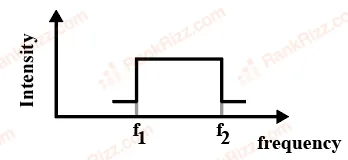
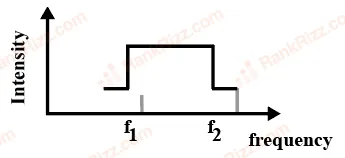
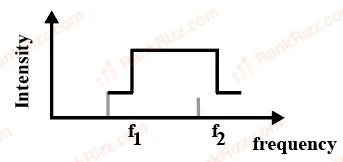
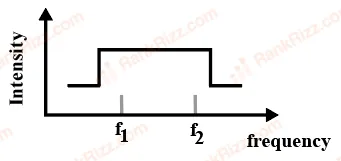
The distribution of the sound intensity of the whistle as observed by the passengers in train A is best represented by

  1. A
    Figure for JEE Advanced 2007 Physics question on Doppler effect in sound
  2. B
    Figure for JEE Advanced 2007 Physics question on Doppler effect in sound
  3. C
    Figure for JEE Advanced 2007 Physics question on Doppler effect in sound
  4. D
    Figure for JEE Advanced 2007 Physics question on Doppler effect in sound
JEE ADVANCED 2007 · PAPER 2Doppler effect in soundTRANSCRIBED

The spread of frequency as observed by the passengersin train B is

  1. A

    310 Hz

  2. B

    330 Hz

  3. C

    350 Hz

  4. D

    290 Hz