JEE Advanced 2025 Physics question — Young's double slit experiment: fringe width and intensity
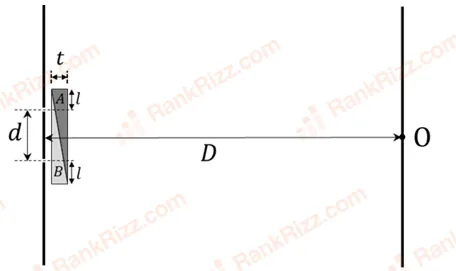
In a Young's double slit experiment, a combination of two glass wedges and , having refractive indices 1.7 and 1.5, respectively, are placed in front of the slits, as shown in the figure. The separation between the slits is mm and the shortest distance between the slits and the screen is m. Thickness of the combination of the wedges is m. The value of as shown in the figure is 1 mm. Neglect any refraction effect at the slanted interface of the wedges. Due to the combination of the wedges, the central maximum shifts (in mm) with respect to O by ______.
SOLUTION
Let the two slits be and , separated by .
The glass combination has a total (constant) physical thickness at every point, but the fractional thicknesses of the two glasses vary linearly along the length of the wedge, as shown in the figure.
Denote the thickness of glass A (refractive index ) in front of a point on the slit plate by .
Consequently, the thickness of glass B (refractive index ) at the same point is , because the total thickness remains .
The slanted interface of the wedges makes the thickness of glass A change from to over the horizontal length .
Therefore, the rate of change (slope) of thickness of glass A along the slit plate is
The two slits are apart. Hence the difference in the thickness of glass A present in front of the two slits is obtained by simple proportion (similar triangles):
This means glass A is thicker in front of one slit than in front of the other. Because the total thickness is fixed, glass B will automatically be thinner at that slit:
The optical path length contributed by a layer of refractive index and physical thickness is (extra path in excess of the same distance in air).
Hence the net path difference introduced between the two slits is
Substituting the numerical values:
In Young’s double-slit arrangement, if one slit receives an additional optical path , the point on the screen where the path difference due to geometry cancels this extra path is the new central maximum. For small angles (screen kept at distance ), the geometric path difference at a point from the original centre is . Setting the total path difference to zero gives
With and , we have
Thus the central maximum shifts by (towards the slit that has the smaller thickness of glass A).
Final answer: 1.2 mm
Tagged Young's double slit experiment: fringe width and intensity. Machine-assigned, so read it as a strong shortlist rather than a verdict.