JEE ADVANCED 2015 · PAPER 1+4HARDTRANSCRIBED
JEE Advanced 2015 Physics question — Young's double slit experiment: fringe width and intensity
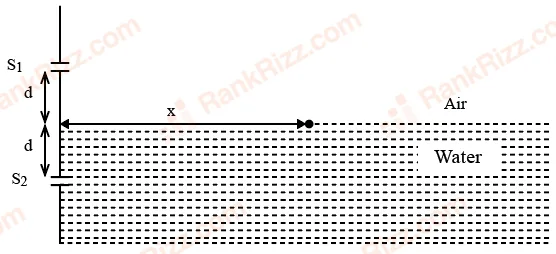
A Young’s double slit interference arrangement with slits and is immersed in water (refractive index = ) as shown in the figure. The positions of maxima on the surface of water are given by , where is the wave length of light in air (refractive index = 1), 2d is the separation between theslits and m is an integer. The valueofp is
SOLUTION
Key idea: In the figure, is above the water surface (light travels in air) and is below it (light travels in water). Compare optical paths to a point on the surface at distance .
- Geometric distance from either slit to the point: .
- Optical path difference:
- Maxima: .
- So , giving and .
Answer: 3
Tagged Young's double slit experiment: fringe width and intensity. Machine-assigned, so read it as a strong shortlist rather than a verdict.