In terms of potential difference V, electric current I, permittivity , permeability and speed of light c, the dimensionally correct equation(s) is(are)
- A
- B
- C
- D
Every Units, Dimensions & Errors question JEE Advanced has set from 2007–2026, grouped by the idea it tests rather than the order of the syllabus. 29 questions across 3 distinct ideas. Free to read, answer key on every one.
Questions
29
Distinct ideas
3
Share of marks
5.1%
Difficulty
EASY
A chapter is not one subject — it is a handful of procedures the examiner reuses. These are the ones Units, Dimensions & Errors questions actually test.
21–29 OF 29 · NEWEST FIRST
In terms of potential difference V, electric current I, permittivity , permeability and speed of light c, the dimensionally correct equation(s) is(are)
Planck’s constant h, speed of light c and gravitational constant G are used to form a unit of length L and a unit of mass M. Thenthe correct option(s) is(are)
To find the distance d over which a signal can be seen clearly in foggy conditions, a railways engineer uses dimensional analysis and assumes that the distance depends on the mass density of the fog, intensity (power/area) SS of the light from the signal and its frequency f. The engineer finds that disproportional to . The value of n is
Using the expression , one calculates the values of d by measuring the corresponding angles in the range 0 to . The wavelength is exactly known and the error in is constant for all values of . As increases from ,
the absolute error in d remains constant.
the absolute error in d increases.
the fractional error in d remains constant.
the fractional error in d decreases.
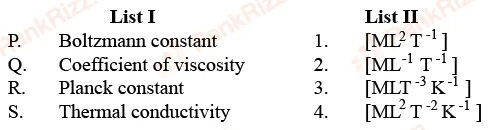
Match List I with List II and select the correct answer using the codes given below the lists :

P-3, Q-1, R-2, S-4
P-3, Q-2, R-1, S-4
P-4, Q-2, R-1, S-3
P-4, Q-1, R-2, S-3
In the determination of Young’s modulus by using Searle’s method,a wire of length L=2 mand diameter d=0.5 mmis used. For a load M= 2.5 kg, an extension l = 0.25 mm in the length of the wire is observed. Quantities d and/ are measured using a screw gauge and a micrometer, respectively. They have the same pitch of 0.5 mm. The number ofdivisions on their circular scale is 100. The contributions to the maximum probable error of the Y measurement
due to the errors in the measurements of d and/ are the same.
due to the error in the measurementof d is twice that dueto the errorin the measurement of l.
due to the error in the measurementof / is twice that due to the error in the measurement of d.
due to the error in the measurementof d is four times that dueto the errorin the measurement of l.
A student uses a simple pendulumof exactly 1m length to determine g, the acceleration due to gravity. He uses a stop watch with the least count of 1 sec for this and records 40 secondsfor 20 oscillations. For this observation, which of the following statement(s) is (are) true ?
Error in measuring T, the time period, is 0.05 seconds
Error in measuring T, the time period, is 1 second
Percentage error in the determination of g is 5%
Percentage error in the determination of g is 2.5%
Students I, II and III perform an experiment for measuring the acceleration due to gravity (g) using a simple pendulum. They use different lengths of the pendulum and/or record time for different number of oscillations. The observations are shown in the table.
Least count for length = 0.1 cm
Least count for time = 0.1 s
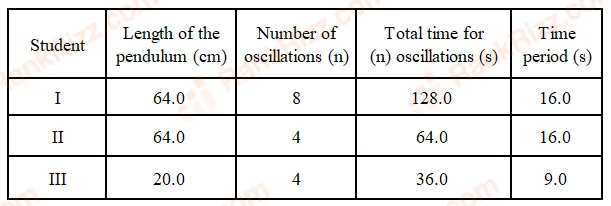
If and are the percentage errors in g, i.e., for students I, II and III, respectively,
is minimum
is maximum
A student performs an experiment to determine the Young’s modulus of a wire, exactly 2 m long, by Searle’s method. In a particular reading, the student measures the extension in the length of the wire to be 0.8 mm with an uncertainty of mm at load of exactly 1.0 kg. The student also measures the diameter of the wire to be 0.4 mm with an uncertainty of mm. Take g = 9.8 m/s (exact). The Young’s modulus obtained from the reading is
JEE Main has set 223 Units, Dimensions & Errors questions too. Units, Dimensions & Errors JEE Main PYQs →
OTHER PHYSICS CHAPTERS