JEE ADVANCED 2011 · PAPER 2MEDIUMTRANSCRIBED
JEE Advanced 2011 Physics question — Fluid pressure, Pascal's law and accelerated/rotating liquids
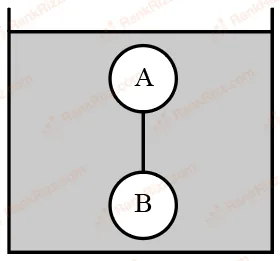
Two solid spheres A and B of equal volumes but of different densities and are connected by a string. They are fully immersed in a fluid of density . They get arranged into an equilibrium state as shown in the figure with a tension in the string. The arrangement is possible only if
SOLUTION
Key idea: The string is taut, so it pulls A down and B up. Apply equilibrium to each sphere separately and then to the whole system. Both spheres have volume .
- Sphere A (top): buoyancy weight :
- Sphere B (bottom): weight buoyancy :
- Whole system (floating, not touching the bottom): total weight total buoyancy:
- So (A), (B) and (D) hold, and (C) contradicts step 1.
Answer: (A), (B), (D)
Tagged Fluid pressure, Pascal's law and accelerated/rotating liquids. Machine-assigned, so read it as a strong shortlist rather than a verdict.