JEE ADVANCED 2009 · PAPER 1MEDIUMTRANSCRIBED
JEE Advanced 2009 Physics question — Electric flux and Gauss's law
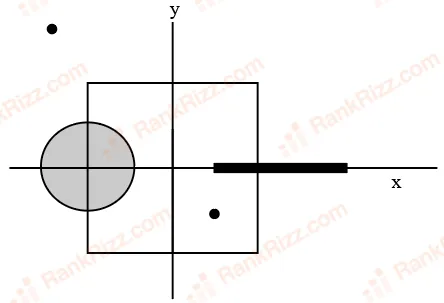
A disk of radius having a uniformly distributed charge 6C is placed in the x-y plane with its centre at . A rod of length 'a' carrying a uniformly distributed charge 8C is placed on the x-axis from to . Two point charges -7C and 3C are placed at and respectively. Consider a cubical surface formed by six surfaces . The electric flux this cubical surface is-
SOLUTION
According to Gauss's law, we have
The enclosed charges are half of the charges in the disc, point charge at , and charge in the rod from point to , that is, 8 C/4. Therefore,
Flux
Tagged Electric flux and Gauss's law. Machine-assigned, so read it as a strong shortlist rather than a verdict.