JEE ADVANCED 2014 · PAPER 1+3MEDIUMTRANSCRIBED
JEE Advanced 2014 Physics question — Wheatstone bridge
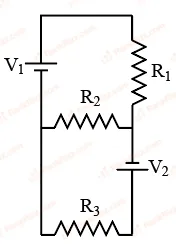
Two ideal batteries of and and three resistances and are connected as shown in the figure. The current in resistance would be zero if
SOLUTION
Key idea: If no current flows in , its two ends (the middle-left and middle-right nodes) are at the same potential. The rest of the circuit is then one series loop.
In the figure, the left vertical wire joins the middle-left node to the bottom-left node, so 's left end is at the same potential as the bottom wire.
- With , the potential difference across equals the emf , so .
- The same current flows on through and back to the bottom-left node. For the middle-right node to be at the same potential as the middle-left node, the drop across must balance : .
- Condition: , i.e. . Note that does not appear.
- Check the options:
- (A) ✓
- (B) and ✓
- (C) but ✗
- (D) and ✓
Answer: (A), (B), (D)
Tagged Wheatstone bridge. Machine-assigned, so read it as a strong shortlist rather than a verdict.