RankRizz
JEE ADVANCED 2022 · PAPER 2+3 / −1HARDTRANSCRIBED

JEE Advanced 2022 Physics question — Potentiometer

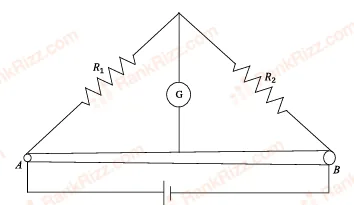
Two resistances R1=XR_1 = X Ω\Omega and R2=1R_2 = 1 Ω\Omega are connected to a wire AB of uniform resistivity, as shown in the figure. The radius of the wire varies linearly along its axis from 0.2 mm at A to 1 mm at B. A galvanometer (G) connected to the center of the wire, 50 cm from each end along its axis, shows zero deflection when A and B are connected to a battery. The value of X is _______.

Figure for JEE Advanced 2022 Physics question on Potentiometer
SOLUTION

The wire ABAB is of length L=1 L = 1\,m and has uniform resistivity ρ\rho, but its radius varies linearly from
rA=0.2 mm=0.0002 r_A = 0.2\text{ mm} = 0.0002\,m at AA to rB=1 mm=0.001 r_B = 1\text{ mm} = 0.001\,m at BB.

Let the distance measured from end AA be xx. Because the radius changes linearly,

r(x)=rA+(rB−rA)xL=0.0002+0.0008 x(0≤x≤1)r(x) = r_A + (r_B - r_A)\frac{x}{L} = 0.0002 + 0.0008\,x \quad (0 \le x \le 1)

The cross-sectional area at position xx is A(x)=π r(x)2A(x) = \pi\,r(x)^2.

For an element of length dxdx the resistance is

dR=ρ dxA(x)=ρ dxπ [ 0.0002+0.0008x ]2dR = \frac{\rho\,dx}{A(x)} = \frac{\rho\,dx}{\pi\,[\,0.0002 + 0.0008x\,]^2}

Integrating gives the resistance between any two points. The integral needed is

∫dx(a+bx)2=−1b (a+bx)where a=0.0002,  b=0.0008\int \frac{dx}{(a + bx)^2} = -\frac{1}{b\,(a + bx)} \qquad\text{where } a = 0.0002,\; b = 0.0008

Resistance of segment ACAC (first 0.5 m)

RAC=ρπ 1b[ 1a−1a+0.5 b ]R_{AC} = \frac{\rho}{\pi}\,\frac{1}{b} \Bigg[\,\frac{1}{a} - \frac{1}{a + 0.5\,b}\,\Bigg]

Substituting 1a=10.0002=5000\frac{1}{a} = \frac{1}{0.0002} = 5000 1a+0.5 b=10.0002+0.0004=10.0006=1666.67\frac{1}{a + 0.5\,b} = \frac{1}{0.0002 + 0.0004} = \frac{1}{0.0006} = 1666.67

⇒RAC∝5000−1666.67=3333.33\Rightarrow R_{AC} \propto 5000 - 1666.67 = 3333.33

Resistance of segment CBCB (last 0.5 m)

RCB=ρπ 1b[ 1a+0.5 b−1a+b ]R_{CB} = \frac{\rho}{\pi}\,\frac{1}{b} \Bigg[\,\frac{1}{a + 0.5\,b} - \frac{1}{a + b}\,\Bigg]

Substituting 1a+b=10.0002+0.0008=10.001=1000\frac{1}{a + b} = \frac{1}{0.0002 + 0.0008} = \frac{1}{0.001} = 1000

⇒RCB∝1666.67−1000=666.67\Rightarrow R_{CB} \propto 1666.67 - 1000 = 666.67

Ratio of the two wire resistances

RACRCB=3333.33666.67=5\frac{R_{AC}}{R_{CB}} = \frac{3333.33}{666.67} = 5

The galvanometer is connected at the midpoint of the wire, forming a Wheatstone bridge with arms:

Left arm: R1R_1 in series with RACR_{AC} Right arm: R2R_2 in series with RCBR_{CB}

For zero deflection (bridge balance),

R1R2=RACRCB=5\frac{R_1}{R_2} = \frac{R_{AC}}{R_{CB}} = 5

Given R2=1 ΩR_2 = 1\,\Omega,

R1=5×1=5 ΩR_1 = 5 \times 1 = 5\,\Omega

Therefore, the required value of XX is 5.

Tagged Potentiometer. Machine-assigned, so read it as a strong shortlist rather than a verdict.

SubjectPhysics
TopicPotentiometer
TypeNumerical answer