JEE Advanced 2020 Physics question — Electric current, current density and drift velocity
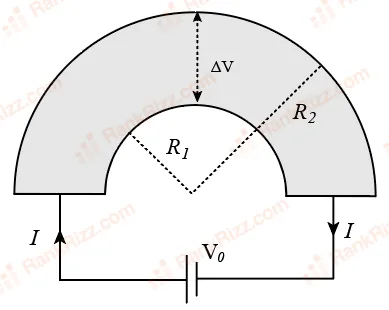
Shown in the figure is a semicircular metallic strip that has thickness t and resistivity . Its inner radius is and outer radius is . If a voltage is applied between its two ends, a current I flows in it. In addition, it is observed that a transverse voltage develops between its inner and outer surfaces due to purely kinetic effects of moving electrons (ignore any role of the magnetic field due to the current). Then (figure is schematic and not drawn to scale)
SOLUTION
Consider a thin semicircular metallic strip that lies in the plane of the page. Its thickness (perpendicular to the page) is , the inner radius is and the outer radius is . A potential difference is applied between the two radial ends, so that current flows along the semicircular path (tangential direction).
1. Equivalent resistance of the strip
Take a differential concentric element of width at radius .
Length of this element (semicircle) = .
Cross-sectional area offered to the tangential current = .
Hence its differential resistance is
All such elements are connected in parallel between the same pair of electrodes, so we add their conductances:
Therefore the equivalent resistance is
2. Current between the two ends
This is exactly the expression given in Option A, so Option A is correct.
3. Drift speed and the required radial (centripetal) force
For the shell at radius the current through that shell is
Current density in that shell:
If the free-electron number density is and electron charge is , the drift velocity is
Every electron must execute circular motion, so it needs a centripetal acceleration , directed radially inwards. The only force available (magnetic field is to be ignored) is the electric force caused by a radial electric field inside the strip:
(The left side is inward, hence negative in the outward radial direction.) Therefore
4. Radial potential difference
Potential difference between the outer and inner surfaces is
(a) The negative sign shows that , i.e. the outer surface is at a lower potential.
This validates Option C and rules out Option B.
(b) All parameters other than (or equivalently ) are constant, so
Hence Option D is also correct.
5. Final set of correct choices
Option A (current expression), Option C (outer surface at lower potential), and Option D (transverse voltage ) are correct.
Tagged Electric current, current density and drift velocity. Machine-assigned, so read it as a strong shortlist rather than a verdict.