JEE MAIN 2024 · 06 APR S1Hydrogen spectrum and spectral seriesTRANSCRIBED
Radius of a certain orbit of hydrogen atom is . If energy of electron in this orbit is , then _______ (Given , energy of electron in ground state).
Every Atoms & Nuclei question JEE Main has set from 2004–2026, grouped by the idea it tests rather than the order of the syllabus. 304 questions across 7 distinct ideas. Free to read, answer key on every one.
Questions
304
Distinct ideas
7
Share of marks
4.8%
Difficulty
EASY
A chapter is not one subject — it is a handful of procedures the examiner reuses. These are the ones Atoms & Nuclei questions actually test.
81–100 OF 304 · NEWEST FIRST
Radius of a certain orbit of hydrogen atom is . If energy of electron in this orbit is , then _______ (Given , energy of electron in ground state).
In Franck-Hertz experiment, the first dip in the current-voltage graph for hydrogen is observed at 10.2 V. The wavelength of light emitted by hydrogen atom when excited to the first excitation level is ___________ nm. (Given , ).
In an alpha particle scattering experiment distance of closest approach for the particle is . If target nucleus has atomic number 80, then maximum velocity of -particle is ______ approximately.
A star has helium composition. It starts to convert three He into one C via triple alpha process as He He He C . The mass of the star is kg and it generates energy at the rate of W. The rate of converting these He to C is s, where n is ________ [Take, mass of He u, mass of C u]
A small particle of mass moves in such a way that its potential energy where is constant and is the distance of the particle from origin. Assuming Bohr's quantization of momentum and circular orbit, the radius of n orbit will be proportional to
If a radioactive element having half-life of min is undergoing beta decay, the fraction of radioactive element remains undecayed after min will be:
Substance has atomic mass number and half life of day. Another substance has atomic mass number and half life of day. If both and simultaneously start undergo radio activity at the same time with initial mass g each, how many total atoms of and combined would be left after days
The energy levels of a hydrogen atom are shown below. The transition corresponding to emission of shortest wavelength is
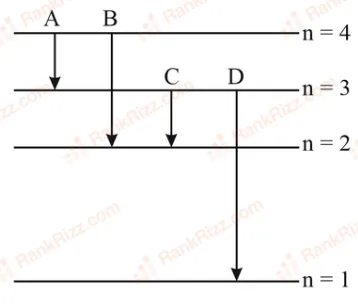
D
A
B
C
Given below are two statements: one is labelled as Assertion A and the other is labelled as Reason R.
Assertion A: The nuclear density of nuclides B, Li, Fe, Ne and Bi can be arranged as
Reason R: The radius of nucleus is related to its mass number as , where is a constant.
In the light of the above statement, choose the correct answer from the options given below:
Both A and R are true and R is the correct explanation of A
A is false but R is true
A is true but R is false
Both A and R are true but R is NOT the correct explanation of A
The half life of a radioactive substance is . The time taken, for disintegrating part of its original mass will be:
2T
3T
T
8T
Consider the following radioactive decay process:
The mass number and the atomic number of are given by:
210 and 82
210 and 84
210 and 80
211 and 80
Consider the following radioactive decay process:
The mass number and the atomic number of are given by:
210 and 82
210 and 84
210 and 80
211 and 80
A free neutron decays into a proton but a free proton does not decay into neutron. This is because
neutron is an uncharged particle
proton is a charged particle
neutron is a composite particle made of a proton and an electron
neutron has larger rest mass than proton
An electron of a hydrogen like atom, having , jumps from energy state to energy state. The energy released in this process, will be: (Given eV, where = Rydberg constant, = Speed of light in vacuum, = Planck's constant)
eV
eV
eV
eV
A eV electron beam is used to bombard gaseous hydrogen at room temperature. The number of spectral lines emitted will be:
A photon is emitted in transition from to level in hydrogen atom. The corresponding wavelength for this transition is (given, eV s)
941 nm
974 nm
99.3 nm
94.1 nm
A B D
In the given nuclear reaction, the approximate amount of energy released will be:
[Given, mass of A MeV c, mass of B MeV c, mass of D MeV c]
MeV
MeV
MeV
MeV
The radius of electron's second stationary orbit in Bohr's atom is . The radius of 3 orbit will be
2.25
The ratio of the density of oxygen nucleus (O) and helium nucleus (He) is
4 : 1
8 : 1
1 : 1
2 : 1
Given below are two statements: one is labelled as Assertion A and the other is labelled as Reason R
Assertion A : The binding energy per nucleon is practically independent of the atomic number for nuclei of mass number in the range 30 to 170.
Reason R : Nuclear force is short ranged.
In the light of the above statements, choose the correct answer from the options given below
A is false but R is true
Both A and R are true and R is the correct explanation of A
Both A and R are true but R is NOT the correct explanation of A
A is true but R is false.
JEE Advanced has set 53 Atoms & Nuclei questions too. Atoms & Nuclei JEE Advanced PYQs →
OTHER PHYSICS CHAPTERS