RankRizz

Atoms & Nuclei — JEE Main Previous Year Questions

Every Atoms & Nuclei question JEE Main has set from 2004–2026, grouped by the idea it tests rather than the order of the syllabus. 304 questions across 7 distinct ideas. Free to read, answer key on every one.

Questions

304

Distinct ideas

7

Share of marks

4.8%

Difficulty

EASY

The ideas inside Atoms & Nuclei

A chapter is not one subject — it is a handful of procedures the examiner reuses. These are the ones Atoms & Nuclei questions actually test.

Every Atoms & Nuclei question

281–300 OF 304 · NEWEST FIRST

JEE MAIN 2010Nuclear size, mass defect and binding energyTRANSCRIBED

A nucleus of mass M+ΔmM + \Delta m is at rest and decays into two daughter nuclei of equal mass M2\frac{M}{2} each. Speed of light is cc. The binding energy per nucleon for the parent nucleus is E1E_1 and that for the daughter nuclei is E2E_2. Then

  1. A

    E2=2E1E_2 = 2 E_1

  2. B

    E1>E2E_1 > E_2

  3. C

    E2>E1E_2 > E_1

  4. D

    E1=2E2E_1 = 2 E_2

JEE MAIN 2010Nuclear fission, fusion and Q-valueTRANSCRIBED

A nucleus of mass M+ΔmM + \Delta m is at rest and decays into two daughter nuclei of equal mass M2\frac{M}{2} each. Speed of light is cc. The speed of daughter nuclei is

  1. A

    cΔmM+Δmc \frac{\Delta m}{M + \Delta m}

  2. B

    c2ΔmMc \sqrt{\frac{2 \Delta m}{M}}

  3. C

    cΔmMc \sqrt{\frac{\Delta m}{M}}

  4. D

    cΔmM+Δmc \sqrt{\frac{\Delta m}{M + \Delta m}}

JEE MAIN 2010Radioactivity: decay law, half-life and decay modesTRANSCRIBED

A radioactive nucleus (initial mass number AA and atomic number ZZ) emits 3 α\alpha-particles and 2 positrons. The ratio of number of neutrons to that of protons in the final nucleus will be

  1. A

    A−Z−8Z−4\frac{A - Z - 8}{Z - 4}

  2. B

    A−Z−4Z−8\frac{A - Z - 4}{Z - 8}

  3. C

    A−Z−12Z−4\frac{A - Z - 12}{Z - 4}

  4. D

    A−Z−4Z−2\frac{A - Z - 4}{Z - 2}

JEE MAIN 2009Hydrogen spectrum and spectral seriesTRANSCRIBED

The transition from the state n=4n = 4 to n=3n = 3 in a hydrogen like atom results in ultraviolet radiation. Infrared radiation will be obtained in the transition from

  1. A

    2→12 \to 1

  2. B

    3→23 \to 2

  3. C

    4→24 \to 2

  4. D

    5→45 \to 4

JEE MAIN 2009Nuclear fission, fusion and Q-valueTRANSCRIBED

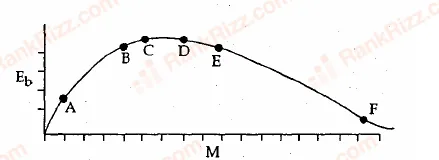
The above is a plot of binding energy per nucleon EbE_b, against the nuclear mass MM; A,B,C,D,E,FA, B, C, D, E, F correspond to different nuclei. Consider four reactions: (i) A+B→C+εA + B \to C + \varepsilon (ii) C→A+B+εC \to A + B + \varepsilon (iii) D+E→F+εD + E \to F + \varepsilon and (iv) F→D+E+εF \to D + E + \varepsilon where ε\varepsilon is the energy released? In which reactions is ε\varepsilon positive? Figure for JEE Main 2009 Physics question on Nuclear fission, fusion and Q-value

  1. A

    (i) and (iv)

  2. B

    (i) and (iii)

  3. C

    (ii) and (iv)

  4. D

    (ii) and (iii)

JEE MAIN 2008Bohr model of hydrogen-like atomsTRANSCRIBED

Suppose an electron is attracted towards the origin by a force k/rk/r where 'kk' is a constant and 'rr' is the distance of the electron from the origin. By applying Bohr model to this system, the radius of the nthn^{th} orbital of the electron is found to be 'rnr_n' and the kinetic energy of the electron to be TnT_n. Then which of the following is true?

  1. A

    Tn∝1/n2, rn∝n2T_n \propto 1/n^2,\ r_n \propto n^2

  2. B

    TnT_n independent of nn, rn∝nr_n \propto n

  3. C

    Tn∝1/n, rn∝nT_n \propto 1/n,\ r_n \propto n

  4. D

    Tn∝1/n, rn∝n2T_n \propto 1/n,\ r_n \propto n^2

JEE MAIN 2008Nuclear fission, fusion and Q-valueTRANSCRIBED

This question contains Statement-1 and Statement-2. Of the four choices given after the statements, choose the one that best describes the two statements. Statement - I: Energy is released when heavy nuclei undergo fission or light nuclei undergo fusion. Statement - II: For heavy nuclei, binding energy per nucleon increases with increasing ZZ while for light nuclei it decrease with increasing ZZ.

  1. A

    Statement-1 is false, Statement-2 is true.

  2. B

    Statement-1 is true, Statement-2 is true; Statement-2 is correct explanation for Statement-1.

  3. C

    Statement-1 is true, Statement-2 is true; Statement-2 is not a correct explanation for Statement-1.

  4. D

    Statement-1 is true, Statement-2 is False.

JEE MAIN 2007Hydrogen spectrum and spectral seriesTRANSCRIBED

Which of the following transitions in hydrogen atoms emit photons of highest frequency?

  1. A

    n=2n = 2 to n=6n = 6

  2. B

    n=6n = 6 to n=2n = 2

  3. C

    n=2n = 2 to n=1n = 1

  4. D

    n=1n = 1 to n=2n = 2

JEE MAIN 2007Nuclear size, mass defect and binding energyTRANSCRIBED

If MoM_o is the mass of an oxygen isotope 8O17_8O^{17}, MpM_p and MNM_N are the masses of a proton and a neutron respectively, the nuclear binding energy of the isotope is

  1. A

    (Mo−8Mp)C2(M_o - 8 M_p) C^2

  2. B

    (Mo−8Mp−9MN)C2(M_o - 8 M_p - 9 M_N) C^2

  3. C

    MoC2M_o C^2

  4. D

    (Mo−17MN)C2(M_o - 17 M_N) C^2

JEE MAIN 2007Radioactivity: decay law, half-life and decay modesTRANSCRIBED

In gamma ray emission from a nucleus

  1. A

    both the neutron number and the proton number change

  2. B

    there is no change in the proton number and the neutron number.

  3. C

    only the neutron number changes

  4. D

    only the proton number changes

JEE MAIN 2007Radioactivity: decay law, half-life and decay modesTRANSCRIBED

The half-life period of a radio-active element XX is same as the mean life time of another radioactive element YY. Initially they have the same number of atoms. Then

  1. A

    XX will decay faster than YY

  2. B

    YY will decay faster than XX

  3. C

    XX and YY have same decay rate initially

  4. D

    XX and YY decay at same rate always.

JEE MAIN 2006Alpha-particle scattering and Rutherford modelTRANSCRIBED

An alpha nucleus of energy 12mv2\dfrac{1}{2}mv^2 bombards a heavy nuclear target of charge ZeZe. Then the distance of closest approach for the alpha nucleus will be proportional to

  1. A

    1Ze\dfrac{1}{Ze}

  2. B

    v2v^2

  3. C

    1m\dfrac{1}{m}

  4. D

    1v4\dfrac{1}{v^4}

JEE MAIN 2006Radioactivity: decay law, half-life and decay modesTRANSCRIBED

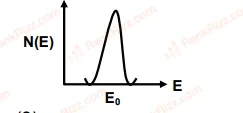
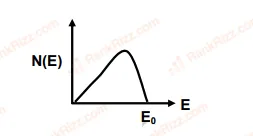
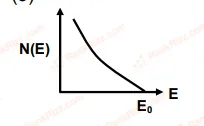
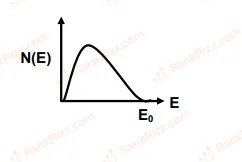
The energy spectrum of β\beta-particles [number N(E)N(E) as a function of β\beta-energy EE] emitted from a radioactive source is

  1. A
    Figure for JEE Main 2006 Physics question on Radioactivity: decay law, half-life and decay modes
  2. B
    Figure for JEE Main 2006 Physics question on Radioactivity: decay law, half-life and decay modes
  3. C
    Figure for JEE Main 2006 Physics question on Radioactivity: decay law, half-life and decay modes
  4. D
    Figure for JEE Main 2006 Physics question on Radioactivity: decay law, half-life and decay modes
JEE MAIN 2006Radioactivity: decay law, half-life and decay modesTRANSCRIBED

When 3Li7_3Li^7 nuclei are bombarded by protons, and the resultant nuclei are 4Be8_4Be^8, the emitted particles will be

  1. A

    neutrons

  2. B

    alpha particles

  3. C

    beta particles

  4. D

    gamma photons

JEE MAIN 2006Radioactivity: decay law, half-life and decay modesTRANSCRIBED

The 'rad' is the correct unit used to report the measurement of

  1. A

    the rate of decay of radioactive source

  2. B

    the ability of a beam of gamma ray photons to produce ions in a target

  3. C

    the energy delivered by radiation to a target.

  4. D

    the biological effect of radiation

JEE MAIN 2006Nuclear fission, fusion and Q-valueTRANSCRIBED

If the binding energy per nucleon in 37Li_3^7Li and 24He_2^4He nuclei are 5.60 MeV5.60\,MeV and 7.06 MeV7.06\,MeV respectively, then in the reaction p+37Li→2 24Hep + _3^7Li \to 2\,_2^4He energy of proton must be

  1. A

    39.2 MeV39.2\,MeV

  2. B

    28.24 MeV28.24\,MeV

  3. C

    17.28 MeV17.28\,MeV

  4. D

    1.46 MeV1.46\,MeV

JEE MAIN 2005Hydrogen spectrum and spectral seriesTRANSCRIBED

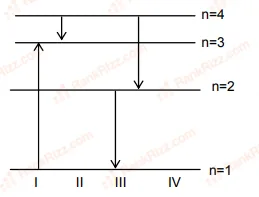
The diagram shows the energy levels for an electron in a certain atom. Which transition shown represents the emission of a photon with the most energy? Figure for JEE Main 2005 Physics question on Hydrogen spectrum and spectral series

  1. A

    III

  2. B

    IV

  3. C

    I

  4. D

    II

JEE MAIN 2005Radioactivity: decay law, half-life and decay modesTRANSCRIBED

The intensity of gamma radiation from a given source is II. On passing through 3636 mm of lead, it is reduced to I8\frac{I}{8}. The thickness of lead which will reduce the intensity to I2\frac{I}{2} will be

  1. A

    66 mm

  2. B

    99 mm

  3. C

    1818 mm

  4. D

    1212 mm

JEE MAIN 2005Radioactivity: decay law, half-life and decay modesTRANSCRIBED

Starting with a sample of pure 66^{66}Cu, 7/87/8 of it decays into Zn in 1515 minutes. The corresponding half-life is

  1. A

    1010 minutes

  2. B

    1515 minutes

  3. C

    55 minutes

  4. D

    7127\frac{1}{2} minutes

JEE MAIN 2005Nuclear size, mass defect and binding energyTRANSCRIBED

If radius of 1327^{27}_{13}Al nucleus is estimated to be 3.63.6 Fermi then the radius of 52125^{125}_{52}Te nucleus be nearly

  1. A

    66 fermi

  2. B

    88 fermi

  3. C

    44 fermi

  4. D

    55 fermi