JEE MAIN 2026Radioactivity: decay law, half-life and decay modesTRANSCRIBED
The activity of a radioactive sample decreases to one tenth of the original activity in a period of one year. After 9 more years its activity would be
- A
- B
- C
- D
Every JEE Main question on Radioactivity: decay law, half-life and decay modes, one of the ideas inside Atoms & Nuclei: 104 questions from 2005–2026, 47 of them in the last five years. Newest first, answer key on every one. Free to read.
Questions
104
Years asked
20
Since
2005
Of the chapter
34%
Questions on Radioactivity: decay law, half-life and decay modes in each year it was asked, the latest 12 of 20.
1–20 OF 104 · NEWEST FIRST
The activity of a radioactive sample decreases to one tenth of the original activity in a period of one year. After 9 more years its activity would be
An atom is bombarded by shower of fundamental particles and in 10s this atom absorbed 10 electrons, 10 protons and 9 neutrons. The surface area of the nucleons is now _____ of initial value.
225%
250%
150%
900%
Which of the following pair of nuclei are isobars of the element?
A nucleus has mass number and radius Another nucleus has mass number and radius . If then is:
1
2
0.5
8
Two radioactive substances A and B of mass numbers 200 and 212 respectively, shows spontaneous -decay with same Q value of 1 MeV. The ratio of energies of -rays produced by A and B is __________.
A radioactive material P first decays into Q and then Q decays to non-radioactive material R. Which of the following figure represents time dependent mass of P, Q and R?
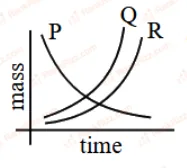
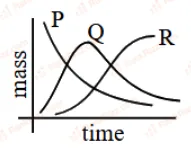
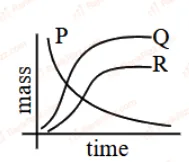
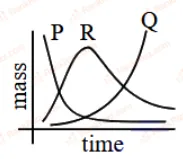
Given below are two statements : one is labelled as Assertion (A) and the other is labelled as Reason (R).
Assertion (A) : The density of the copper nucleus is greater than that of the carbon nucleus.
Reason (R) : The nucleus of mass number A has a radius proportional to .
In the light of the above statements, choose the most appropriate answer from the options given below :
(A) is correct but (R) is not correct
(A) is not correct but (R) is correct
Both (A) and (R) are correct and (R) is the correct explanation of (A)
Both (A) and (R) are correct but (R) is not the correct explanation of (A)
Choose the correct nuclear process from the below options [p: proton, n : neutron, :electron, : positron, : neutrino, : antineutrino]
A radioactive nucleus has 3 times the decay constant as compared to the decay constant of another radioactive nucleus . If initial number of both nuclei are the same, what is the ratio of number of nuclei of to the number of nuclei of , after one half-life of ?
1/8
8
4
1/4
For a nucleus of mass number A and radius R, the mass density of nucleus can be represented as
Independent of A
The mass number of nucleus having radius equal to half of the radius of nucleus with mass number 192 is:
24
32
40
20
The radius of a nucleus of mass number is fermi. Then the mass number of another nucleus having radius of fermi is , where is _________.
A nucleus has mass number and volume . Another nucleus has mass number and volume . If relation between mass number is , then
If a radioactive element having half-life of min is undergoing beta decay, the fraction of radioactive element remains undecayed after min will be:
Substance has atomic mass number and half life of day. Another substance has atomic mass number and half life of day. If both and simultaneously start undergo radio activity at the same time with initial mass g each, how many total atoms of and combined would be left after days
Given below are two statements: one is labelled as Assertion A and the other is labelled as Reason R.
Assertion A: The nuclear density of nuclides B, Li, Fe, Ne and Bi can be arranged as
Reason R: The radius of nucleus is related to its mass number as , where is a constant.
In the light of the above statement, choose the correct answer from the options given below:
Both A and R are true and R is the correct explanation of A
A is false but R is true
A is true but R is false
Both A and R are true but R is NOT the correct explanation of A
The half life of a radioactive substance is . The time taken, for disintegrating part of its original mass will be:
2T
3T
T
8T
Consider the following radioactive decay process:
The mass number and the atomic number of are given by:
210 and 82
210 and 84
210 and 80
211 and 80
Consider the following radioactive decay process:
The mass number and the atomic number of are given by:
210 and 82
210 and 84
210 and 80
211 and 80
A free neutron decays into a proton but a free proton does not decay into neutron. This is because
neutron is an uncharged particle
proton is a charged particle
neutron is a composite particle made of a proton and an electron
neutron has larger rest mass than proton