The binding energy for the following nuclear reactions are expressed in MeV.
MeV
MeV
If , , denote the stability of and respectively, then the correct order is :
- A
- B
- C
- D
Every JEE Main question on Nuclear size, mass defect and binding energy, one of the ideas inside Atoms & Nuclei: 54 questions from 2004–2026, 39 of them in the last five years. Newest first, answer key on every one. Free to read.
Questions
54
Years asked
15
Since
2004
Of the chapter
18%
Questions on Nuclear size, mass defect and binding energy in each year it was asked, the latest 12 of 15.
1–20 OF 54 · NEWEST FIRST
The binding energy for the following nuclear reactions are expressed in MeV.
MeV
MeV
If , , denote the stability of and respectively, then the correct order is :
Two nuclei of mass number 3 combine with another nucleus of mass number 4 to yield a nucleus of mass number 10. If the binding energy per nucleon for the mass numbers 3, 4 and 10 are 5.6 MeV, 7.4 MeV and 6.1 MeV, respectively, then in the process, = _____ MeV.
The minimum frequency of photon required to break a particle of mass 15.348 amu into particles is ____ kHz.
[mass of He nucleus and ]
The energy released if hydrogen atoms are combined to form He is __________ MeV. (Take binding energies per nucleon of H and He as 1.1 MeV and 7.2 MeV, respectively)
6.1
24.4
26.6
5
Given below are two statements:
Statement I: For all elements, greater the mass of the nucleus, greater is the binding energy per nucleon.
Statement II: For all elements, nuclei with less binding energy per nucleon transforms to nuclei with greater binding energy per nucleon.
In the light of the above statements, choose the correct answer from the options given below
Statement I is true but Statement II is false
Both Statement I and Statement II are true
Both Statement I and Statement II are false
Statement I is false but Statement II is true
Assuming the experimental mass of as 12 u, The mass defect of atom is (in MeV/) :
(Mass of proton = 1.00727 u, mass of neutron = 1.00866 u, 1 u = 931.5MeV/ and c is the speed of the light in vacuum).
The energy released when kg of Li is converted into He by proton bombardment is eV. The value of is _______. (Nearest integer)
(Mass of Li = 7.0183 u, mass of He = 4.004 u, mass of proton = 1.008 u and 1 u = 931 MeV/c and Avogadro number = )
The average energy released per fission for the nucleus of is 190 MeV.
When all the atoms of 47g pure undergo fission process, the energy released is MeV. The value of is ______.
(Avogadro Number = 6 per mole)
The binding energy per nucleon of is _________ MeV. [Take u, u, u, u MeV/c]
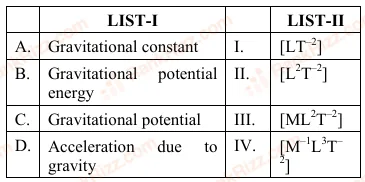
Match the LIST-I with LIST-II.
Choose the correct answer from the options given below :
A-IV, B-III, C-II, D-I
A-III, B-II, C-I, D-IV
A-II, B-IV, C-III, D-I
A-I, B-III, C-IV, D-II
Energy released when two deuterons fuse to form a helium nucleus is :
(Given : Binding energy per nucleon of MeV and binding energy per nucleon of MeV)
MeV
MeV
MeV
MeV
Given below are two statements. One is labelled as Assertion (A) and the other is labelled as Reason (R). Assertion (A) : The binding energy per nucleon is found to be practically independent of the atomic number A, for nuclei with mass numbers between 30 and 170. Reason (R): Nuclear force is long range. In the light of the above statements, choose the correct answer from the options given below :
(A) is true but (R) is false
(A) is false but (R) is true
Both (A) and (R) are true and (R) is the correct explanation of (A)
Both (A) and (R) are true but (R) is NOT the correct explanation of (A)
If is the mass of isotope , and are the masses of proton and neutron, then nuclear binding energy of isotope is :
A nucleus at rest disintegrates into two smaller nuclei with their masses in the ratio of . After disintegration they will move :
in the same direction with same speed.
in opposite directions with the same speed.
in opposite directions with speed in the ratio of respectively.
The atomic mass of is 12.000000 u and that of is 13.003354 u. The required energy to remove a neutron from , if mass of neutron is 1.008665 u, will be :
62.5 MeV
6.25 MeV
4.95 MeV
49.5 MeV
In a nuclear fission reaction of an isotope of mass , three similar daughter nuclei of same mass are formed. The speed of a daughter nuclei in terms of mass defect will be:
Binding energy of a certain nucleus is . How much is the difference between total mass of all the nucleons and nuclear mass of the given nucleus:
In a hypothetical fission reaction . The identity of emitted particles (R) is :
Electron
Neutron
-radiations
Proton
The energy equivalent of g of substance is :
MeV
MeV
MeV
eV
The energy released in the fusion of of hydrogen deep in the sun is and the energy released in the fission of of is . The ratio is approximately: (Consider the fusion reaction as , energy released in the fission reaction of is per fission nucleus and )
7.62
25.6
15.04
9.13