RankRizz

Atoms & Nuclei — JEE Main Previous Year Questions

Every Atoms & Nuclei question JEE Main has set from 2004–2026, grouped by the idea it tests rather than the order of the syllabus. 304 questions across 7 distinct ideas. Free to read, answer key on every one.

Questions

304

Distinct ideas

7

Share of marks

4.8%

Difficulty

EASY

The ideas inside Atoms & Nuclei

A chapter is not one subject — it is a handful of procedures the examiner reuses. These are the ones Atoms & Nuclei questions actually test.

Every Atoms & Nuclei question

121–140 OF 304 · NEWEST FIRST

JEE MAIN 2023 · 31 JAN S2Hydrogen spectrum and spectral seriesTRANSCRIBED

If the binding energy of ground state electron in a hydrogen atom is 13.6 eV, then, the energy required to remove the electron from the second excited state of Li2+^{2+} will be: x×10−1x \times 10^{-1} eV. The value of xx is ______.

JEE MAIN 2023 · 25 JAN S1Hydrogen spectrum and spectral seriesTRANSCRIBED

The wavelength of the radiation emitted is λ0\lambda_0 when an electron jumps from the second excited state to the first excited state of hydrogen atom. If the electron jumps from the third excited state to the second orbit of the hydrogen atom, the wavelength of the radiation emitted will be 20xλ0\frac{20}{x}\lambda_0. The value of xx is _____.

JEE MAIN 2023 · 06 APR S1Hydrogen spectrum and spectral seriesTRANSCRIBED

The radius of fifth orbit of Li++^{++} is ______ ×10−12\times 10^{-12} m. Take: radius of hydrogen atom = 0.51 A˚\mathring{A}

JEE MAIN 2023 · 15 APR S1Hydrogen spectrum and spectral seriesTRANSCRIBED

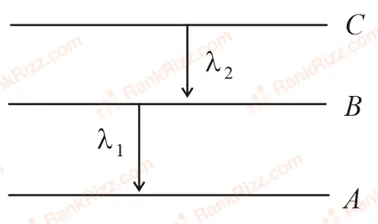
As per the given figure AA, BB and CC are the first, second and third excited energy levels of hydrogen atom respectively. If the ratio of the two wavelengths (i.e. λ1λ2\frac{\lambda_1}{\lambda_2}) is 74n\frac{7}{4n}, then the value of nn will be _____.

Figure for JEE Main 2023 Physics question on Hydrogen spectrum and spectral series
JEE MAIN 2023 · 08 APR S2Hydrogen spectrum and spectral seriesTRANSCRIBED

The ratio of wavelength of spectral lines HαH_\alpha and HβH_\beta in the Balmer series is x20\frac{x}{20}. The value of xx is _____.

JEE MAIN 2023 · 01 FEB S1Hydrogen spectrum and spectral seriesTRANSCRIBED

A light of energy 12.75 eV is incident on a hydrogen atom in its ground state. The atom absorbs the radiation and reaches to one of its excited states. The angular momentum of the atom in the excited state is xπ×10−17\frac{x}{\pi} \times 10^{-17} eVs. The value of xx is _____ (use h=4.14×10⁻¹⁵h = 4.14 \times 10^{-15} eVs, c=3×10⁸c = 3 \times 10^8 m s−1^{-1})

JEE MAIN 2023 · 10 APR S1Radioactivity: decay law, half-life and decay modesTRANSCRIBED

The decay constant for a radioactive nuclide is 1.5×10−51.5 \times 10^{-5} s−1^{-1}. Atomic weight of the substance is 60 g mole−1^{-1}, NA=6×10²³N_A = 6 \times 10^{23}. The activity of 1.0 μ\mug of the substance is _______ ×1010\times 10^{10} Bq.

JEE MAIN 2023 · 30 JAN S2Radioactivity: decay law, half-life and decay modesTRANSCRIBED

A radioactive nucleus decays by two different process. The half life of the first process is 55 minutes and that of the second process is 3030 s. The effective half-life of the nucleus is calculated to be α11\frac{\alpha}{11} s. The value of α\alpha is ______.

JEE MAIN 2023 · 08 APR S1Nuclear size, mass defect and binding energyTRANSCRIBED

A nucleus with mass number 242 and binding energy per nucleon as 7.6 MeV breaks into two fragment each with mass number 121. If each fragment nucleus has binding energy per nucleon as 8.1 MeV, the total gain in binding energy is ______ MeV.

JEE MAIN 2023 · 10 APR S2Hydrogen spectrum and spectral seriesTRANSCRIBED

If 917 A˚\mathring{\text{A}} be the lowest wavelength of Lyman series then the lowest wavelength of Balmer series will be _______ A˚\mathring{\text{A}}.

JEE MAIN 2023 · 11 APR S1Hydrogen spectrum and spectral seriesTRANSCRIBED

A monochromatic light is incident on a hydrogen sample in ground state. Hydrogen atoms absorb a fraction of light and subsequently emit radiation of six different wavelengths. The frequency of incident light is x×1015x \times 10^{15} Hz. The value of x is _______.
(Given h=4.25×10⁻¹⁵h = 4.25 \times 10^{-15} eVs)

JEE MAIN 2022 · 25 JUL S1Bohr model of hydrogen-like atomsTRANSCRIBED

The magnetic moment of an electron (ee) revolving in an orbit around nucleus with an orbital angular momentum is given by

  1. A

    μ⃗L=eL⃗2m\vec{\mu}_L = \dfrac{e\vec{L}}{2m}

  2. B

    μ⃗L=−eL⃗2m\vec{\mu}_L = -\dfrac{e\vec{L}}{2m}

  3. C

    μ⃗L=−eL⃗m\vec{\mu}_L = -\dfrac{e\vec{L}}{m}

  4. D

    μ⃗L=2eL⃗m\vec{\mu}_L = \dfrac{2e\vec{L}}{m}

JEE MAIN 2022 · 28 JUN S1Nuclear size, mass defect and binding energyTRANSCRIBED

The QQ-value of a nuclear reaction and kinetic energy of the projectile particle, KpK_p are related as

  1. A

    Q=KpQ = K_p

  2. B

    (Kp+Q)<0(K_p + Q) < 0

  3. C

    Q<KpQ < K_p

  4. D

    (Kp+Q)>0(K_p + Q) > 0

JEE MAIN 2022 · 29 JUL S1Hydrogen spectrum and spectral seriesTRANSCRIBED

Find the ratio of energies of photons produced due to transition of an electron of hydrogen atom from its (i) second permitted energy level to the first level, and (ii) the highest permitted energy level to the first permitted level.

  1. A

    3 : 4

  2. B

    4 : 3

  3. C

    1 : 4

  4. D

    4 : 1

JEE MAIN 2022 · 24 JUN S1Alpha-particle scattering and Rutherford modelTRANSCRIBED

Choose the correct option from the following options given below :

  1. A

    In the ground state of Rutherford's model electrons are in stable equilibrium. While in Thomson's model electrons always experience a net-force.

  2. B

    An atom has a nearly continuous mass distribution in a Rutherford's model but has a highly non-uniform mass distribution in Thomson's model

  3. C

    A classical atom based on Rutherford's model is doomed to collapse.

  4. D

    The positively charged part of the atom possesses most of the mass in Rutherford's model but not in Thomson's model.

JEE MAIN 2022 · 25 JUN S1Hydrogen spectrum and spectral seriesTRANSCRIBED

The ratio for the speed of the electron in the 3rd3^{rd} orbit of He+He^+ to the speed of the electron in the 3rd3^{rd} orbit of hydrogen atom will be :

  1. A

    1:11 : 1

  2. B

    1:21 : 2

  3. C

    4:14 : 1

  4. D

    2:12 : 1

JEE MAIN 2022 · 25 JUN S2Radioactivity: decay law, half-life and decay modesTRANSCRIBED

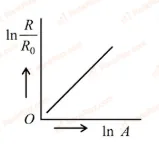
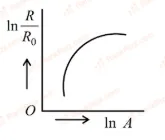
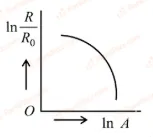
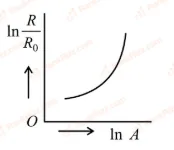
Which of the following figure represents the variation of ln⁡RR0\ln\frac{R}{R_0} with ln⁡A\ln A (if RR = radius of a nucleus and AA = its mass number)?

  1. A
    Figure for JEE Main 2022 Physics question on Radioactivity: decay law, half-life and decay modes
  2. B
    Figure for JEE Main 2022 Physics question on Radioactivity: decay law, half-life and decay modes
  3. C
    Figure for JEE Main 2022 Physics question on Radioactivity: decay law, half-life and decay modes
  4. D
    Figure for JEE Main 2022 Physics question on Radioactivity: decay law, half-life and decay modes
JEE MAIN 2022 · 26 JUN S1Radioactivity: decay law, half-life and decay modesTRANSCRIBED

How many alpha and beta particles are emitted when Uranium 92U238_{92}U^{238} decays to lead 82Pb206_{82}Pb^{206}?

  1. A

    3 alpha particles and 5 beta particles

  2. B

    6 alpha particles and 4 beta particles

  3. C

    4 alpha particles and 5 beta particles

  4. D

    8 alpha particles and 6 beta particles

JEE MAIN 2022 · 26 JUN S2Radioactivity: decay law, half-life and decay modesTRANSCRIBED

A radioactive nucleus can decay by two different processes. Half-life for the first process is 3.03.0 hours while it is 4.54.5 hours for the second process. The effective halflife of the nucleus will be

  1. A

    3.753.75 hours

  2. B

    0.560.56 hours

  3. C

    0.260.26 hours

  4. D

    1.801.80 hours

JEE MAIN 2022 · 27 JUN S2Hydrogen spectrum and spectral seriesTRANSCRIBED

Given below are two statements
Statement I: In hydrogen atom, the frequency of radiation emitted when an electron jumps from lower energy orbit (E1E_1) to higher energy orbit (E2E_2), is given as hf=E1−E2hf = E_1 - E_2
Statement II: The jumping of electron from higher energy orbit (E2E_2) to lower energy orbit (E1E_1) is associated with frequency of radiation given as f=(E2−E1)hf = \frac{(E_2-E_1)}{h}. This condition is Bohr's frequency condition.
In the light of the above statements, choose the correct answer from the options given below:
  1. A

    Both statement I and statement II are true.

  2. B

    Both statement I and statement II are false.

  3. C

    Statement I is correct but statement II is false.

  4. D

    Statement I is incorrect but statement II is true.