JEE MAIN 2023 · 06 APR S1+4 / −1EASYTRANSCRIBED
JEE Main 2023 Physics question — Hydrogen spectrum and spectral series
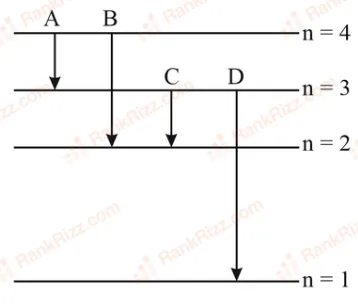
The energy levels of a hydrogen atom are shown below. The transition corresponding to emission of shortest wavelength is
SOLUTION
The energy of a photon emitted during a transition is given by Planck's relation:
To find the shortest wavelength (), we look for the transition with the largest energy difference ().
Energy levels of a hydrogen atom ():
, , ,
Transition A ():
Transition B ():
Transition C ():
Transition D ():
Since transition D involves the ground state (), it has the largest energy gap, which results in the shortest emitted wavelength.
Tagged Hydrogen spectrum and spectral series. Machine-assigned, so read it as a strong shortlist rather than a verdict.