RankRizz

Atoms & Nuclei — JEE Main Previous Year Questions

Every Atoms & Nuclei question JEE Main has set from 2004–2026, grouped by the idea it tests rather than the order of the syllabus. 304 questions across 7 distinct ideas. Free to read, answer key on every one.

Questions

304

Distinct ideas

7

Share of marks

4.8%

Difficulty

EASY

The ideas inside Atoms & Nuclei

A chapter is not one subject — it is a handful of procedures the examiner reuses. These are the ones Atoms & Nuclei questions actually test.

Every Atoms & Nuclei question

241–260 OF 304 · NEWEST FIRST

JEE MAIN 2017 · 08 APR ONLINEHydrogen spectrum and spectral seriesTRANSCRIBED

According to Bohr's theory, the time averaged magnetic field at the centre (i.e., nucleus) of a hydrogen atom due to the motion of electrons in the nthn^{th} orbit is proportional to: (nn = principal quantum number)

  1. A

    n−3n^{-3}

  2. B

    n−2n^{-2}

  3. C

    n−4n^{-4}

  4. D

    n−5n^{-5}

JEE MAIN 2017 · 02 APR OFFLINEHydrogen spectrum and spectral seriesTRANSCRIBED

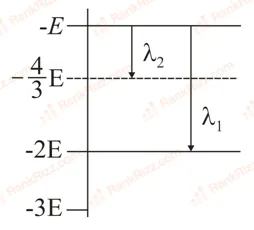
Some energy levels of a molecule are shown in the figure. The ratio of the wavelengths r=λ1λ2r = \frac{\lambda_{1}}{\lambda_{2}}, is given by:

Figure for JEE Main 2017 Physics question on Hydrogen spectrum and spectral series
  1. A

    r=13r = \frac{1}{3}

  2. B

    r=43r = \frac{4}{3}

  3. C

    r=23r = \frac{2}{3}

  4. D

    r=34r = \frac{3}{4}

JEE MAIN 2017 · 08 APR ONLINENuclear size, mass defect and binding energyTRANSCRIBED

Two deuterons undergo nuclear fusion to form a Helium nucleus. The energy released in this process is (given binding energy per nucleon for deuteron = 1.1 MeV and for helium = 7.0 MeV):

  1. A

    23.6 MeV

  2. B

    30.2 MeV

  3. C

    25.8 MeV

  4. D

    32.4 MeV

JEE MAIN 2017 · 09 APR ONLINEHydrogen spectrum and spectral seriesTRANSCRIBED

The acceleration of an electron in the first orbit of the hydrogen atom (n=1n = 1) is:

  1. A

    h24πm2r3\frac{h^2}{4\pi m^2 r^3}

  2. B

    h2π2m2r3\frac{h^2}{\pi^2 m^2 r^3}

  3. C

    h28π2m2r3\frac{h^2}{8\pi^2 m^2 r^3}

  4. D

    h24π2m2r3\frac{h^2}{4\pi^2 m^2 r^3}

JEE MAIN 2017 · 02 APR OFFLINERadioactivity: decay law, half-life and decay modesTRANSCRIBED

A radioactive nucleus AA with a half-life TT, decays into a nucleus BB. At t=0t = 0, there is no nucleus BB. At some time tt, the ratio of the number of BB to that of AA is 0.3. Then, tt is given by: (Consider log⁡ex=log⁡x\log_{e} x = \log x)

  1. A

    t=Tlog⁡1.3t = \frac{T}{\log 1.3}

  2. B

    t=Tlog⁡22log⁡1.3t = \frac{T \log 2}{2 \log 1.3}

  3. C

    t=Tlog⁡1.3log⁡2t = T\frac{\log 1.3}{\log 2}

  4. D

    t=Tlog⁡1.3t = T\log 1.3

JEE MAIN 2017 · 09 APR ONLINENuclear size, mass defect and binding energyTRANSCRIBED

Imagine that a reactor converts all the given mass into energy and that it operates at a power level of 10910^9 Watt. The mass of the fuel consumed per hour, in the reactor, will be: (velocity of light, cc is 3×1083 \times 10^8 m s−1^{-1})

  1. A

    6.6×10−56.6 \times 10^{-5} g

  2. B

    0.96 g

  3. C

    4×10⁻²⁴ \times 10^{-2} g

  4. D

    0.8 g

JEE MAIN 2016 · 03 APR OFFLINERadioactivity: decay law, half-life and decay modesTRANSCRIBED

Half-lives of two radioactive elements A and B are 20 minutes and 40 minutes, respectively. Initially, the samples have an equal number of nuclei. After 80 minutes, the ratio of decayed numbers of A and B nuclei will be:

  1. A

    1 : 4

  2. B

    5 : 4

  3. C

    1 : 16

  4. D

    4 : 1

JEE MAIN 2016 · 09 APR ONLINEHydrogen spectrum and spectral seriesTRANSCRIBED

An electron in a hydrogen atom makes a transition from n=2n = 2 to n=1n = 1 and emits a photon. This photon strikes a doubly ionized lithium atom which was already in an excited state and completely removes the orbiting electron. The least quantum number for the excited state of the lithium-ion for the process is

  1. A

    2

  2. B

    4

  3. C

    5

  4. D

    3

JEE MAIN 2016 · 10 APR ONLINEHydrogen spectrum and spectral seriesTRANSCRIBED

A neutron moving with a speed 'v' makes a head on collision with a stationary hydrogen atom in ground state. The minimum kinetic energy of the neutron for which perfectly inelastic collision will take place is:

  1. A

    20.4 eV

  2. B

    10.2 eV

  3. C

    12.1 eV

  4. D

    16.8 eV

JEE MAIN 2015 · 10 APR ONLINEHydrogen spectrum and spectral seriesTRANSCRIBED

If one were to apply the Bohr model to a particle of mass mm and charge qq moving in a plane under the influence of a magnetic field 'B', the energy of the charged particle in the nthn^{th} level will be:

  1. A

    n(hqBπm)n\left(\frac{hqB}{\pi m}\right)

  2. B

    n(hqB4πm)n\left(\frac{hqB}{4\pi m}\right)

  3. C

    n(hqB2πm)n\left(\frac{hqB}{2\pi m}\right)

  4. D

    n(hqB8πm)n\left(\frac{hqB}{8\pi m}\right)

JEE MAIN 2015 · 11 APR ONLINEHydrogen spectrum and spectral seriesTRANSCRIBED

The de-Broglie wavelength associated with the electron in the n=4n = 4 level is:

  1. A

    Half of the de-Broglie wavelength of the electron in the ground state

  2. B

    Four times the de-Broglie wavelength of the electron in the ground state

  3. C

    14\frac{1}{4}th of the de-Broglie wavelength of the electron in the ground state

  4. D

    Two times the de-Broglie wavelength of the electron in the ground state

JEE MAIN 2015 · 04 APR OFFLINEHydrogen spectrum and spectral seriesTRANSCRIBED

As an electron makes a transition from an excited state to the ground state of a hydrogen-like atom/ion

  1. A

    kinetic energy and total energy decrease but potential energy increases

  2. B

    its kinetic energy increases but potential energy and total energy decrease

  3. C

    kinetic energy, potential energy and total energy decrease

  4. D

    kinetic energy decreases, potential energy increases but total energy remains same

JEE MAIN 2015 · 11 APR ONLINERadioactivity: decay law, half-life and decay modesTRANSCRIBED

Let NβN_\beta be the number of β\beta particle emitted by 1 gram of Na24^{24} radioactive nuclei having a half life of 15 h. In 7.5 h, the number NβN_\beta is close to [NA=6.023×10²³[N_A = 6.023 \times 10^{23} mole−1]^{-1}]

  1. A

    1.75×10221.75 \times 10^{22}

  2. B

    6.2×10216.2 \times 10^{21}

  3. C

    7.5×10217.5 \times 10^{21}

  4. D

    1.25×10221.25 \times 10^{22}

JEE MAIN 2014 · 06 APR OFFLINEHydrogen spectrum and spectral seriesTRANSCRIBED

The radiation corresponding to 3→23 \to 2 transition of hydrogen atom falls on a metal surface to produce photoelectrons. These electrons are made to enter a magnetic field of 3×10−43 \times 10^{-4} T. If the radius of the largest circular path followed by these electrons is 10.0 mm, the work function of the metal is close to:

  1. A

    1.8 eV

  2. B

    1.1 eV

  3. C

    0.8 eV

  4. D

    1.6 eV

JEE MAIN 2014 · 09 APR ONLINEHydrogen spectrum and spectral seriesTRANSCRIBED

If the binding energy of the electron in a hydrogen atom is 13.6 eV, the energy required to remove the electron from the first excited state of Li++^{++} is:

  1. A

    13.6 eV

  2. B

    3.4 eV

  3. C

    122.4 eV

  4. D

    30.6 eV

JEE MAIN 2014 · 19 APR ONLINERadioactivity: decay law, half-life and decay modesTRANSCRIBED

A piece of wood from a recently cut tree shows 20 decays per minute. A wooden piece of the same size placed in a museum (obtained from a tree cut many years back) shows 2 decays per minute. If the half-life of C14^{14} is 5730 years, then the age of the wooden piece placed in the museum is approximately: [This question was awarded a bonus and proper correction was made to avoid that]

  1. A

    10439 years

  2. B

    39049 years

  3. C

    19042 years

  4. D

    13094 years

JEE MAIN 2014 · 06 APR OFFLINEHydrogen spectrum and spectral seriesTRANSCRIBED

Hydrogen (1H1_1H^1), Deuterium (1H2_1H^2), singly ionised Helium (2He4_2He^4)+^+ and doubly ionised lithium (3Li6_3Li^6)++^{++} all have one electron around the nucleus. Consider an electron transition from n=2n = 2 to n=1n = 1. If the wave lengths of emitted radiation are λ1\lambda_1, λ2\lambda_2, λ3\lambda_3 and λ4\lambda_4 respectively then approximately which one of the following is correct?

  1. A

    4λ1=2λ2=2λ3=λ44\lambda_1 = 2\lambda_2 = 2\lambda_3 = \lambda_4

  2. B

    λ1=2λ2=2λ3=λ4\lambda_1 = 2\lambda_2 = 2\lambda_3 = \lambda_4

  3. C

    λ1=λ2=4λ3=9λ4\lambda_1 = \lambda_2 = 4\lambda_3 = 9\lambda_4

  4. D

    λ1=2λ2=3λ3=4λ4\lambda_1 = 2\lambda_2 = 3\lambda_3 = 4\lambda_4

JEE MAIN 2014 · 11 APR ONLINERadioactivity: decay law, half-life and decay modesTRANSCRIBED

A radioactive nuclei with decay constant 0.5/s is being produced at a constant rate of 100 nuclei/s. If at t = 0 there were no nuclei, the time when there are 50 nuclei is:

  1. A

    1 s

  2. B

    2ln⁡(43)2\ln\left(\frac{4}{3}\right) s

  3. C

    ln⁡2\ln 2 s

  4. D

    ln⁡(43)\ln\left(\frac{4}{3}\right) s

JEE MAIN 2014 · 12 APR ONLINERadioactivity: decay law, half-life and decay modesTRANSCRIBED

A piece of bone of an animal from a ruin is found to have 14^{14}C activity of 12 disintegrations per minute per gm of its carbon content. The 14^{14}C activity of a living animal is 16 disintegrations per minute per gm. How long ago nearly did the animal die? (Given half life of 14^{14}C is t1/2t_{1/2} = 5760 years)

  1. A

    1672 years

  2. B

    2391 years

  3. C

    3291 years

  4. D

    4453 years

JEE MAIN 2013 · 09 APR ONLINEHydrogen spectrum and spectral seriesTRANSCRIBED

In the Bohr model an electron moves in a circular orbit around the proton. Considering the orbiting electron to be a circular current loop, the magnetic moment of the hydrogen atom, when the electron is in nthn^{th} excited state, is :

  1. A

    (e2m)n2h2π\left(\frac{e}{2m}\right)\frac{n^2h}{2\pi}

  2. B

    (em)nh2π\left(\frac{e}{m}\right)\frac{nh}{2\pi}

  3. C

    (e2m)nh2π\left(\frac{e}{2m}\right)\frac{nh}{2\pi}

  4. D

    (em)n2h2π\left(\frac{e}{m}\right)\frac{n^2h}{2\pi}