RankRizz

Atoms & Nuclei — JEE Main Previous Year Questions

Every Atoms & Nuclei question JEE Main has set from 2004–2026, grouped by the idea it tests rather than the order of the syllabus. 304 questions across 7 distinct ideas. Free to read, answer key on every one.

Questions

304

Distinct ideas

7

Share of marks

4.8%

Difficulty

EASY

The ideas inside Atoms & Nuclei

A chapter is not one subject — it is a handful of procedures the examiner reuses. These are the ones Atoms & Nuclei questions actually test.

Every Atoms & Nuclei question

261–280 OF 304 · NEWEST FIRST

JEE MAIN 2013 · 23 APR ONLINEHydrogen spectrum and spectral seriesTRANSCRIBED

In the Bohr's model of hydrogen-like atom the force between the nucleus and the electron is modified as F=e24πϵ0(1r2+βr3)F = \frac{e^2}{4\pi\epsilon_0}\left(\frac{1}{r^2} + \frac{\beta}{r^3}\right), where β\beta is a constant. For this atom, the radius of the nthn^{th} orbit in terms of the Bohr radius (a0=ϵ0h2mπe2)\left(a_0 = \frac{\epsilon_0 h^2}{m\pi e^2}\right) is :

  1. A

    rn=a0n−βr_n = a_0 n - \beta

  2. B

    rn=a0n2+βr_n = a_0 n^2 + \beta

  3. C

    rn=a0n2−βr_n = a_0 n^2 - \beta

  4. D

    rn=a0n+βr_n = a_0 n + \beta

JEE MAIN 2013 · 07 APR ONLINEHydrogen spectrum and spectral seriesTRANSCRIBED

In a hydrogen like atom electron makes transition from an energy level with quantum number n to another with quantum number (n - 1). If n >> 1, the frequency of radiation emitted is proportional to :

  1. A

    1n3/2\frac{1}{n^{3/2}}

  2. B

    1n3\frac{1}{n^3}

  3. C

    1n\frac{1}{n}

  4. D

    1n2\frac{1}{n^2}

JEE MAIN 2013 · 09 APR ONLINENuclear size, mass defect and binding energyTRANSCRIBED

When Uranium is bombarded with neutrons, it undergoes fission. The fission reaction can be written as :
92U235+0n1→56Ba141+36Kr92+3x+Q_{92}U^{235} + {}_0n^1 \rightarrow {}_{56}Ba^{141} + {}_{36}Kr^{92} + 3x + Q(energy) where three particles named x are produced and energy Q is released. What is the name of the particle x?

  1. A

    electron

  2. B

    α\alpha-particle

  3. C

    neutron

  4. D

    neutrino

JEE MAIN 2013 · 25 APR ONLINEHydrogen spectrum and spectral seriesTRANSCRIBED

A 12.5 eV electron beam is used to bombard gaseous hydrogen at room temperature. It will emit:

  1. A

    2 lines in the Lyman series and 1 line in the Balmer series

  2. B

    3 lines in the Lyman series

  3. C

    1 line in the Lyman series and 2 lines in the Balmer series

  4. D

    3 lines in the Balmer series

JEE MAIN 2013 · 22 APR ONLINERadioactivity: decay law, half-life and decay modesTRANSCRIBED

The half-life of a radioactive element A is the same as the mean-life of another radioactive element B. Initially both substances have the same number of atoms, then :

  1. A

    A and B decay at the same rate always.

  2. B

    A and B decay at the same rate initially.

  3. C

    A will decay at a faster rate than B.

  4. D

    B will decay at a faster rate than A.

JEE MAIN 2012Hydrogen spectrum and spectral seriesTRANSCRIBED

Hydrogen atom is excited from ground state to another state with principal quantum number equal to 44. Then the number of spectral lines in the emission spectra will be

  1. A

    22

  2. B

    33

  3. C

    55

  4. D

    66

JEE MAIN 2012Bohr model of hydrogen-like atomsTRANSCRIBED

A diatomic molecule is made of two masses m1m_1 and m2m_2 which are separated by a distance rr. If we calculate its rotational energy by applying Bohr's rule of angular momentum quantization, its energy will be given by (nn is an integer)

  1. A

    (m1+m2)2n2h22m12m22r2\frac{(m_1+m_2)^2 n^2 h^2}{2 m_1^2 m_2^2 r^2}

  2. B

    n2h22(m1+m2)r2\frac{n^2 h^2}{2(m_1+m_2)r^2}

  3. C

    2n2h2(m1+m2)r2\frac{2 n^2 h^2}{(m_1+m_2)r^2}

  4. D

    (m1+m2)n2h22m1m2r2\frac{(m_1+m_2) n^2 h^2}{2 m_1 m_2 r^2}

JEE MAIN 2012Nuclear size, mass defect and binding energyTRANSCRIBED

Assume that a neutron breaks into a proton and an electron. The energy released during this process is (Mass of neutron =1.6725×10−27=1.6725 \times 10^{-27} kg; mass of proton =1.6725×10−27= 1.6725 \times 10^{-27} kg; mass of electron =9×10−31= 9 \times 10^{-31} kg)

  1. A

    0.730.73 MeV

  2. B

    7.107.10 MeV

  3. C

    6.306.30 MeV

  4. D

    5.45.4 MeV

JEE MAIN 2012Hydrogen spectrum and spectral seriesTRANSCRIBED

The electron of a hydrogen atom makes a transition from the (n+1)th(n+1)^{\text{th}} orbit to the nthn^{\text{th}} orbit. For large nn the wavelength of the emitted radiation is proportional to

  1. A

    nn

  2. B

    n3n^3

  3. C

    n4n^4

  4. D

    n2n^2

JEE MAIN 2012Alpha-particle scattering and Rutherford modelTRANSCRIBED

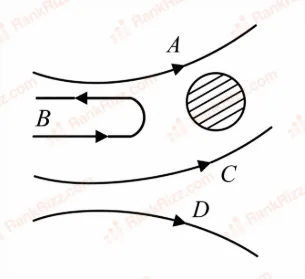
In the Rutherford experiment, α\alpha-particles are scattered from a nucleus as shown. Out of the four paths, which path is not possible?

Figure for JEE Main 2012 Physics question on Alpha-particle scattering and Rutherford model
  1. A

    DD

  2. B

    BB

  3. C

    CC

  4. D

    AA

JEE MAIN 2012Radioactivity: decay law, half-life and decay modesTRANSCRIBED

A sample originally contained 102010^{20} radioactive atoms, which emit α\alpha-particles. The ratio of α\alpha particles emitted in the third year to that emitted during the second year is 0.3. How many α\alpha particles were emitted in the first year?

  1. A

    3×10183 \times 10^{18}

  2. B

    3×10193 \times 10^{19}

  3. C

    5×10185 \times 10^{18}

  4. D

    7×10197 \times 10^{19}

JEE MAIN 2012Bohr model of hydrogen-like atomsTRANSCRIBED

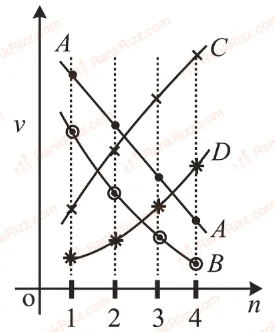
Which of the plots shown in the figure represents speed (vv) of the electron in a hydrogen atom as a function of the principal quantum number (nn)?

Figure for JEE Main 2012 Physics question on Bohr model of hydrogen-like atoms
  1. A

    BB

  2. B

    DD

  3. C

    CC

  4. D

    AA

JEE MAIN 2012Radioactivity: decay law, half-life and decay modesTRANSCRIBED

The counting rate observed from a radioactive source at t=0t = 0 was 1600 counts s−1^{-1}, and t=8t = 8 s, it was 100 counts s−1^{-1}. The counting rate observed as counts s−1^{-1} at t=6t = 6 s will be

  1. A

    250

  2. B

    400

  3. C

    300

  4. D

    200

JEE MAIN 2012Bohr model of hydrogen-like atomsTRANSCRIBED

Ionisation energy of Li (Lithium) atom in ground state is 5.45.4eV. Binding energy of an electron in Li+^+ion in ground state is 75.675.6eV. Energy required to remove all three electrons of Lithium (Li) atom is

  1. A

    81.081.0eV

  2. B

    135.4135.4eV

  3. C

    203.4203.4eV

  4. D

    156.6156.6eV

JEE MAIN 2012Radioactivity: decay law, half-life and decay modesTRANSCRIBED

The decay constants of a radioactive substance for α\alpha and β\beta emission are λα\lambda_\alpha and λβ\lambda_\beta respectively. If the substance emits α\alpha and β\beta simultaneously, then the average half life of the material will be

  1. A

    2TαTβTα+Tβ\frac{2T_\alpha T_\beta}{T_\alpha + T_\beta}

  2. B

    Tα+TβT_\alpha + T_\beta

  3. C

    TαTβTα+Tβ\frac{T_\alpha T_\beta}{T_\alpha + T_\beta}

  4. D

    12(Tα+Tβ)\frac{1}{2}(T_\alpha + T_\beta)

JEE MAIN 2012Hydrogen spectrum and spectral seriesTRANSCRIBED

A hypothetical atom has only three energy levels. The ground level has energy, E1=−8E_1 = -8 eV. The two excited states have energies, E2=−6E_2 = -6 eV and E3=−2E_3 = -2 eV. Then which of the following wavelengths will not be present in the emission spectrum of this atom?

  1. A

    207207 nm

  2. B

    465465 nm

  3. C

    310310 nm

  4. D

    620620 nm

JEE MAIN 2012Hydrogen spectrum and spectral seriesTRANSCRIBED

A doubly ionised Li atom is excited from its ground state (n=1n = 1) to n=3n = 3 state. The wavelengths of the spectral lines are given by λ32\lambda_{32}, λ31\lambda_{31} and λ21\lambda_{21}. The ratio λ32/λ31\lambda_{32}/\lambda_{31} and λ21/λ31\lambda_{21}/\lambda_{31} are, respectively

  1. A

    8.1,0.678.1, 0.67

  2. B

    8.1,1.28.1, 1.2

  3. C

    6.4,1.26.4, 1.2

  4. D

    6.4,0.676.4, 0.67

JEE MAIN 2012Radioactivity: decay law, half-life and decay modesTRANSCRIBED

Which of the following Statements is correct?

  1. A

    The rate of radioactive decay cannot be controlled but that of nuclear fission can be controlled.

  2. B

    Nuclear forces are short range, attractive and charge dependent.

  3. C

    Nuclei of atoms having same number of neutrons are known as isobars.

  4. D

    Wavelength of matter waves is given by de Broglie formula but that of photons is not given by the same formula.

JEE MAIN 2011Bohr model of hydrogen-like atomsTRANSCRIBED

Energy required for the electron excitation in Li++\text{Li}^{++} from the first to the third Bohr orbit is:

  1. A

    36.3 eV36.3 \, \text{eV}

  2. B

    108.8 eV108.8 \, \text{eV}

  3. C

    122.4 eV122.4 \, \text{eV}

  4. D

    12.1 eV12.1 \, \text{eV}

JEE MAIN 2011Radioactivity: decay law, half-life and decay modesTRANSCRIBED

The half life of a radioactive substance is 20 minutes. The approximate time interval (t2−t1)(t_2 - t_1) between the time t2t_2 when 23\dfrac{2}{3} of it has decayed and time t1t_1 and 13\dfrac{1}{3} of it had decayed is:

  1. A

    14 min14 \, \text{min}

  2. B

    20 min20 \, \text{min}

  3. C

    28 min28 \, \text{min}

  4. D

    7 min7 \, \text{min}