JEE MAIN 2009TRANSCRIBED
JEE Main 2009 Physics question — Nuclear fission, fusion and Q-value
The above is a plot of binding energy per nucleon , against the nuclear mass ; correspond to different nuclei. Consider four reactions: (i) (ii) (iii) and (iv) where is the energy released? In which reactions is positive? 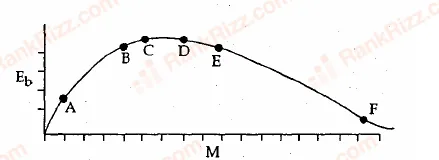
SOLUTION
Key idea: Energy is released () when the products have a higher binding energy per nucleon than the reactants.
- From the graph, and are light nuclei with lower than . So fusion (i) increases binding energy, and energy is released. Reaction (ii) is the reverse, so it needs energy.
- is a heavy nucleus with low , while and (near the peak) have higher . So fission (iv) releases energy. Reaction (iii) is the reverse, so it absorbs energy.
- Therefore is positive for (i) and (iv).
Answer: (A) (i) and (iv)
Tagged Nuclear fission, fusion and Q-value. Machine-assigned, so read it as a strong shortlist rather than a verdict.