JEE ADVANCED 2011 · PAPER 1EASYTRANSCRIBED
JEE Advanced 2011 Physics question — Thermal radiation: Stefan's law, Wien's law and Kirchhoff's law
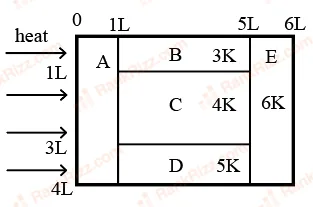
A composite book is made of slabs A, B, C, D and E of different thermal conductivities (given in terms of a constant K) and sizes (given in terms of length, L) as shown in the figure. All slabs are of same width. Heat 'Q' flow only from left to right through the blocks. Then in steady state-
SOLUTION
Key idea: Treat the slabs as thermal resistances . A, the parallel set (B, C, D) and E are in series. Take width ; the heights are A: , B: , C: , D: , E: .
- (A) A and E are in series with everything else, so each carries the full heat current . Correct.
- Resistances (with from the original figure): Middle conductance , so .
- (C) In series, . is the smallest, so the temperature drop across E is the smallest. Correct.
- (D) B, C and D share the same , so their heat flows are proportional to their conductances: for C, and for B + D. So flow through C equals flow through B plus flow through D. Correct.
- (B) E carries the total flow, but A carries exactly the same, so E is not uniquely the maximum. The standard key treats (B) as not correct.
Answer: (A), (C), (D)
Tagged Thermal radiation: Stefan's law, Wien's law and Kirchhoff's law. Machine-assigned, so read it as a strong shortlist rather than a verdict.