JEE ADVANCED 2010 · PAPER 1Spring-block oscillationsTRANSCRIBED
For periodic motion of small amplitude A, the time period T of this particle is proportional to
- A
- B
- C
- D
Every Oscillations question JEE Advanced has set from 2008–2026, grouped by the idea it tests rather than the order of the syllabus. 27 questions across 5 distinct ideas. Free to read, answer key on every one.
Questions
27
Distinct ideas
5
Share of marks
3.1%
Difficulty
MEDIUM
A chapter is not one subject — it is a handful of procedures the examiner reuses. These are the ones Oscillations questions actually test.
21–27 OF 27 · NEWEST FIRST
For periodic motion of small amplitude A, the time period T of this particle is proportional to
The acceleration of this particle for is
proportional to
proportional to
proportional to
zero
A 0.1 kg mass is suspended from a wire of negligible mass. The length of the wire is 1m and its cross-sectional area is . If the mass is pulled a little in
the vertically downward direction and released, it performs simple harmonic motion of angular frequency 140 rad . If the Young’s modulus of the material of the wire is , the value of n is
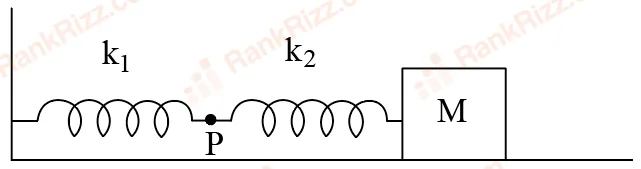
The mass M shown in the figure oscillates in simple harmonic motion with amplitude A. The amplitude of the point P is
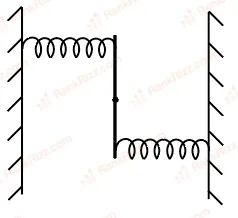
A uniform rod of length L and mass M is pivoted at the centre. Its two ends are attached to two springs of equal spring constants k. The springs are fixed to rigid supports as shown in the figure, and the rod is free to oscillate in the horizontal plane. The rod is gently pushed through a small angle in one direction and released. The frequency of oscillation is
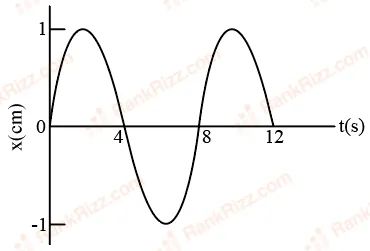
The x-t graph of a particle undergoing simple harmonic is shown below. The acceleration of the particle at is-
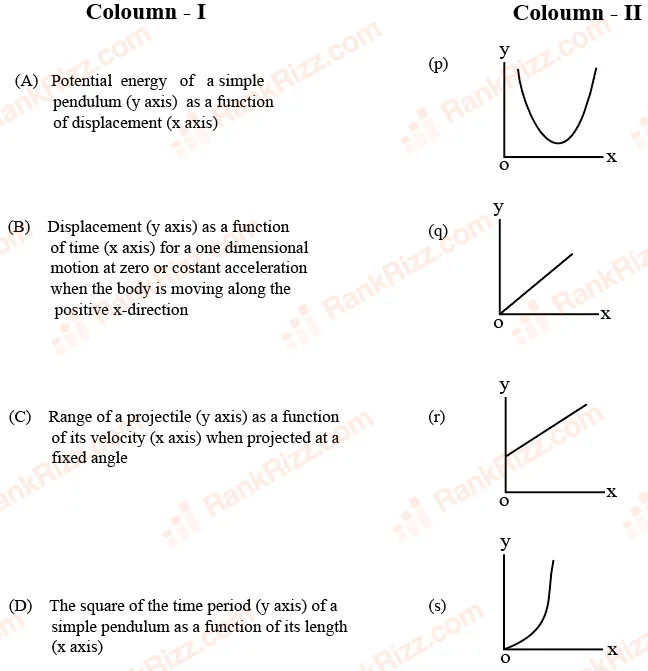
Column I gives a list of possible set of parameters measured in some experiments. The variations of the parameters in the form of graphs are shown in Column II. Match the set of parameters given in Column I with the graphs given in Column II. Indicate your answer by darkening the appropriate bubbles of the matrix given in the ORS.
JEE Main has set 182 Oscillations questions too. Oscillations JEE Main PYQs →
OTHER PHYSICS CHAPTERS