JEE ADVANCED 2010 · PAPER 1MEDIUMTRANSCRIBED
JEE Advanced 2010 Physics question — Gravitational potential energy of systems
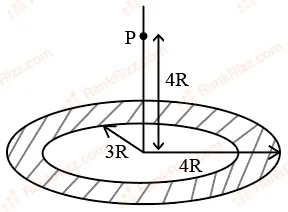
A thin uniform annular disc (see figure) of mass M has outer radius 4R and inner radius 3R. The work required to take a unit mass from point P on its axis to infinity is
SOLUTION
Key idea: Split the annulus into thin rings and add their potentials at P. The work to take unit mass to infinity is .
- Surface density: .
- A ring of radius and width has mass . Its distance from P (on the axis, at height ) is .
- Potential at P:
- Work required: , which is positive, as it should be.
Answer: (A)
Tagged Gravitational potential energy of systems. Machine-assigned, so read it as a strong shortlist rather than a verdict.